Methods · 8 min read
Process Mapping for Consultants: From Current-State Evidence to a Client Decision
A decision-first method for process mapping: charter the decision, register evidence honestly, map the current state, then narrow findings into future-state choices a client can actually decide on.
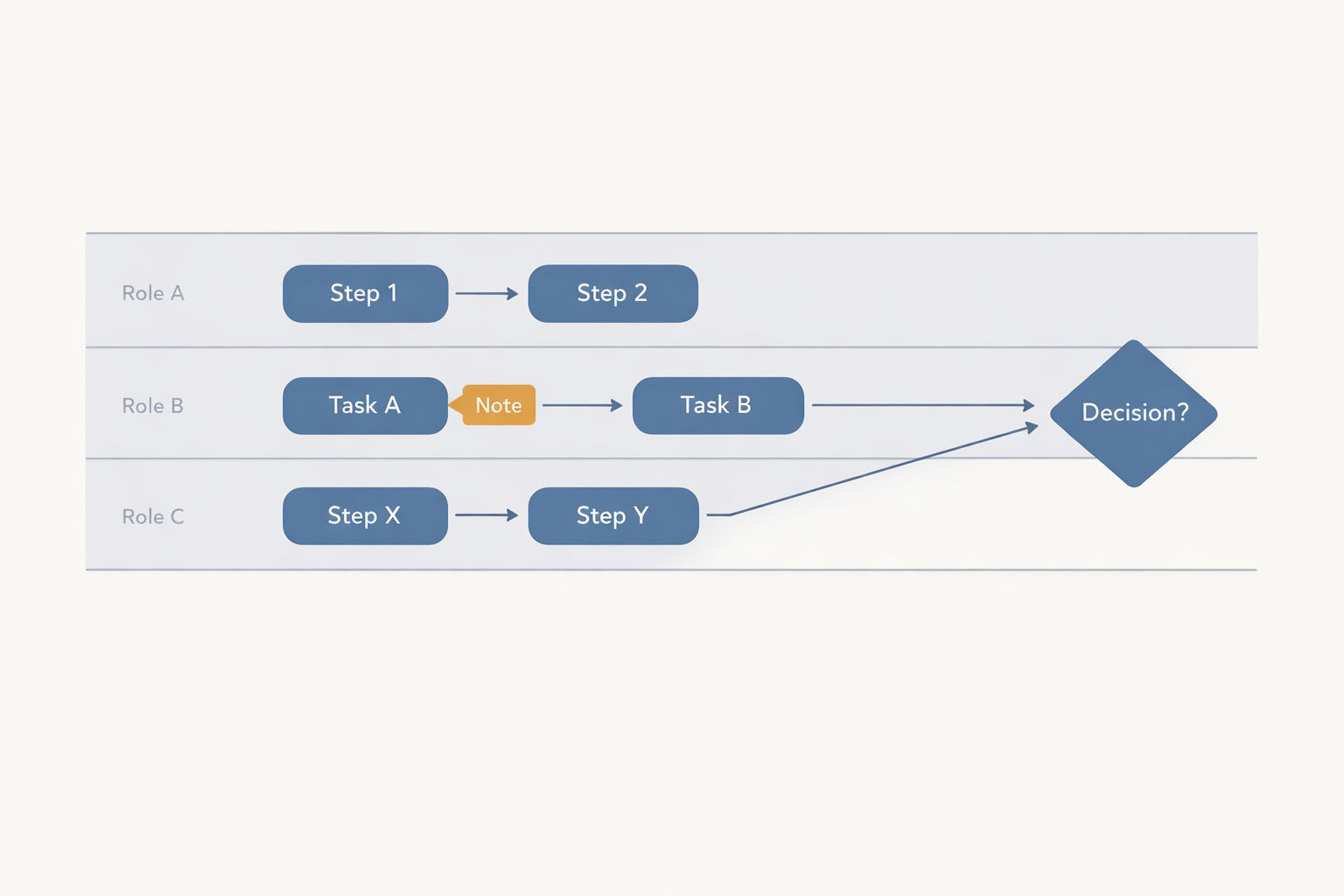
Most process mapping engagements end the same way: a tidy diagram everyone approves and no one acts on. The map is drawn, validated, dropped into a readout deck, and six months later the same handoffs are still failing. The diagram was never the point.
A consultant is paid to deliver a decision a client can defend — a decision about what is actually wrong and what to change first. The map earns its place only as the evidence that carries the client from the current state to that decision.
Process mapping for consultants is a decision chain
The sequence below runs from a decision charter, through an evidence register and a current-state process map, to a bounded finding, future-state choices, and a roadmap that ends in a recorded decision. It is one serviceable method, not a certification. A process map is a model of how work runs, not an objective picture of reality — it earns trust by being honest about what it observed, what it was told, what it assumed, and what it still does not know.
The sequence: six artefacts from question to decision
- Decision charter
Name the decision, its owner, the boundary of the process, and what a useful answer would let the client do — before any evidence is gathered.
- Evidence register
Record every source and mark each claim as observed, reported, assumed or unresolved, with the source and date attached.
- Current-state map
Draw how the work actually runs, step by step, traceable to the register, and validated by the people who do the work.
- Bounded finding
Turn the map into a specific claim: what the evidence supports, where it applies, and what it cannot yet say.
- Future-state choices
Set out genuine options on a common baseline, not a strawman standing next to a favourite.
- Roadmap and decision
Sequence the chosen direction into owned actions with a reversal condition, and record the decision the client makes.
Start with the decision, not the symptom
Clients rarely hand over a clean question. They hand over a conclusion — “we need to automate onboarding” — or a symptom — “the process is too slow.” Both embed a diagnosis before any evidence exists. The charter's job is to pull the engagement back to a decision the client can actually make.
Write the charter before you gather evidence. If you cannot write the process trigger and its end state in one sentence each, you are not ready to hold a workshop. The charter also fixes a quiet failure: a sponsor expecting a definitive, whole-department answer while you deliver a bounded review of one workflow.
A decision charter is not a project plan in disguise. It is a short document — often a page — that names who will decide and what evidence would change their mind.
Keep an evidence register, not a pile of notes
The register is a simple table that sits underneath the map. Every claim about the process gets one row: the claim, its source, and a status. The status is where most process mapping for consultants goes wrong, because interviews, documents and observations tend to be recorded as if they carried equal weight. They do not.
Four statuses cover nearly everything you will meet. The discipline is to use them honestly, and to record contradictions instead of resolving them quietly.
| Status | What it means | Example |
|---|---|---|
| Observed | You saw it, or it sits in a primary record | A timestamped system log; a screen walkthrough you ran |
| Reported | Someone told you; treat it as a claim to check | “Underwriting review is the long pole,” per the operations lead |
| Assumed | A declared working inference, not a fact | “Weekend volume behaves like weekday volume” |
| Unresolved | An open question that could change the map or finding | Whether queue timestamps cover all reviewers |
Build the current-state map from the register
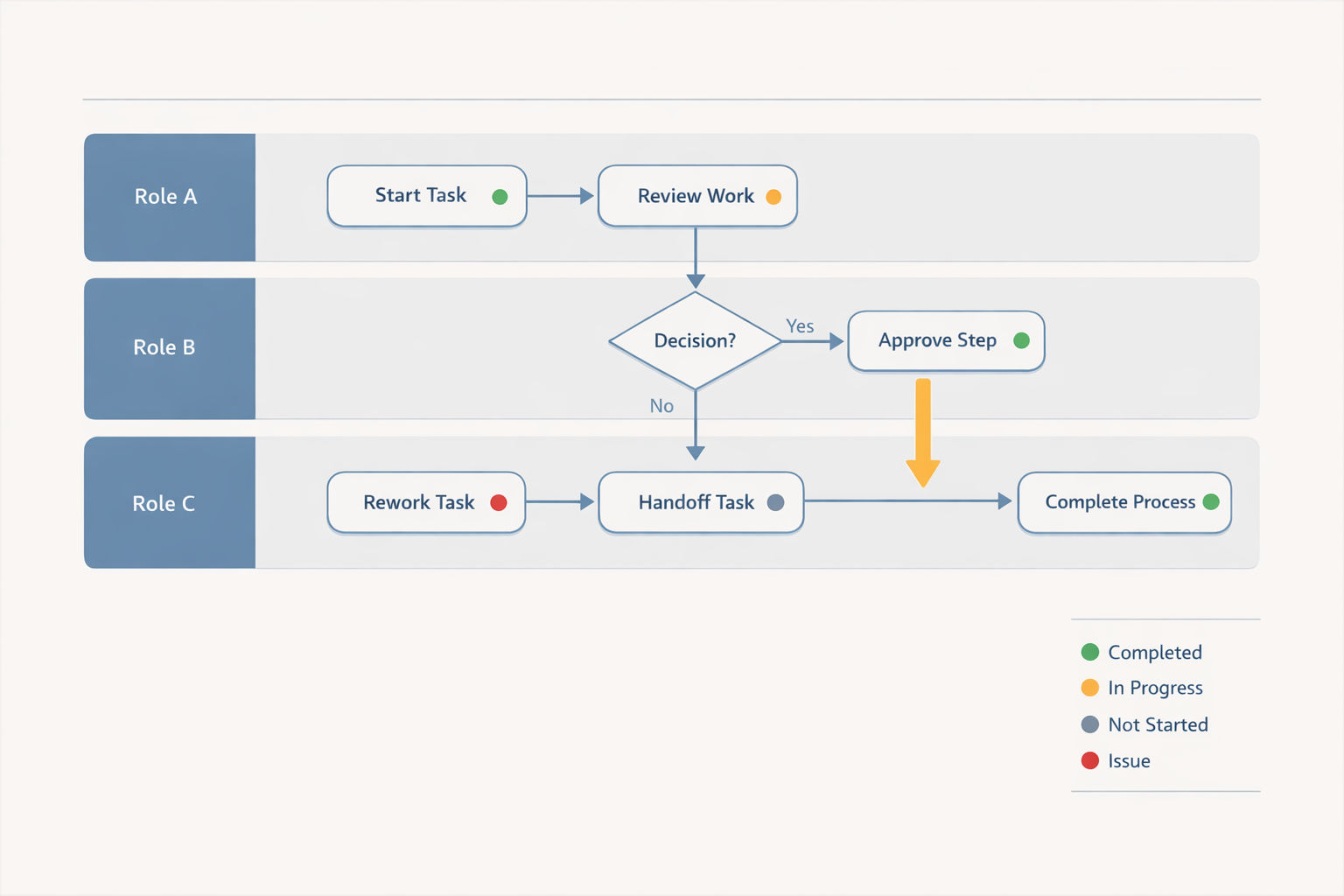
The current state process map is a swimlane view of how work actually runs today — not the documented procedure, and not the process anyone wishes existed. Draw it from the register, not from memory: each step carries its status, so a step you observed and a step someone merely described never look identical on the page.
In a process mapping workshop, hold a few disciplines. Capture the happy path first and park every exception on a visible list; exceptions otherwise derail the narrative before it forms. Ask “who touches it next?” at every handoff, because people describe their own step well and the boundary badly. Name the system exactly — “then it goes into the CRM,” not “then it goes into the system” — because a map without tooling is useless as scope.
Then validate in the room. Read the map back step by step and get explicit agreement, not “looks fine.” A map nobody has confirmed is still a draft, however polished it looks.
Narrow each finding until it is bounded
The map is not the finding. The finding is the sentence that changes a decision. A bounded finding states the claim, the scope it applies to, the evidence behind it, and — explicitly — what it does not yet support. “Eight of ten sampled files sat in the client's queue for five days or more” is bounded. “Intake is broken” is a slogan.
Boundedness is what protects the client from acting on a plausible story. A finding that outruns its evidence commits money and attention to a cause that was never tested.
The hardest part is contradiction. When two sources disagree about the same step, that disagreement is itself a finding — the process is not standardised — not a mistake to smooth over. Never average two contradictory accounts into a confident middle.
Offer future-state choices, not a recommendation with a costume
Clients can smell a strawman. Lay out genuine options on the same baseline: what each changes, what must be true for it to work, what it costs in effort and risk, and which evidence is still missing. Include “continue as today” when it is genuinely available. Describe the recommended option and the alternatives with the same care, and attach a reversal condition to the one you favour — the observation that would tell the client to stop.
End in a roadmap and a decision
A future-state map with no plan behind it stays on the wall. Turn the chosen direction into a small number of owned actions, sequenced so the cheap, informative moves come first. Name one accountable owner per action and a date. Where an outcome is promised, define the baseline and the measure before the work starts — an estimated benefit is a planning input until it is measured.
In process improvement consulting, the measure of a map is not its neatness but the decision it changes. The last artefact is a decision record: what was chosen, what was deferred, what was assumed, and what would reverse it. The decision belongs to the client. Your test is whether the client can explain and defend it without you in the room.
A synthetic example: quote-to-bind at Halewood & Finch
Synthetic example — invented to illustrate the method; not a real client or engagement.
Halewood & Finch, a regional insurance broker, asks a consultant to help with a slow quote-to-bind process. The sponsor's framing is already a solution: “underwriting is understaffed — help us add capacity or automate the review.”
The consultant does not accept the framing. The charter records the real decision: which change to the quote-to-bind process should we make first? The boundary runs from signed quote to policy bound; pricing and commissions are out of scope; success is a shorter median elapsed time without a higher error rate.
The evidence register fills up quickly. A system export shows median elapsed time from signed quote to bound at nine days, with roughly six of those days in the client document-completion step across the six files examined. A walkthrough shows intake returning to the client twice on average for missing documents, each return adding days. The operations lead reports that underwriting review is “the long pole.” And the underwriting queue data turns out to be partial — timestamps exist for some reviewers and not others.
| Claim | Status | Source | What it does |
|---|---|---|---|
| Median elapsed time is 9 days; about 6 of them sit in client document completion | Observed | System export + review of 6 recent files | Locates the largest observed delay upstream of underwriting |
| Intake returns to the client about twice per file for missing documents | Observed | Walkthrough of 6 files with the intake team | Identifies a fixable, repeated source of delay |
| “Underwriting review is the long pole” | Reported | Operations lead interview | A claim to check, not yet established |
| The sponsor's belief that underwriting is understaffed | Assumed | Sponsor brief | A hypothesis, held separately from evidence |
| Whether the underwriting queue timestamps are complete | Unresolved | Queue data export | Determines whether the reported cause can be tested |
The operations lead's account and the timestamps point in different directions. The reported cause is underwriting capacity; the observed data place most elapsed time upstream, in document completion. The unresolved queue data means neither can be ruled out.
The finding is therefore bounded, and narrower than the sponsor's ask: intake rework is the largest observed, addressable delay in the sample; underwriting capacity cannot be assessed on the current data. The recommendation narrows accordingly — it does not endorse hiring underwriters or buying automation. It proposes two moves: fix intake first, with a document checklist and a completeness gate at submission, and instrument the underwriting queue so every reviewer's timestamps are captured. The capacity decision is deferred until the queue data is complete.
The future-state choices are written on one baseline. Option A tightens intake only. Option B tightens intake and instruments the queue, then re-reads the capacity question in six weeks. Option C adds underwriting capacity now. The consultant recommends B, with a reversal condition: if complete queue data shows underwriting time dominating even after intake is fixed, the client moves to C. The roadmap sequences the checklist and gate in the first two weeks, the instrumented measurement across weeks three to eight, and a recorded decision at week nine. Nothing in the example is a measured result; it is a decision the client can now make and defend.
A self-audit before you start
Before your next process mapping engagement, test the scaffold against the work in front of you:
- Can I write the decision, its owner and its boundary in one paragraph?
- For every step on my map, can I name the status — observed, reported, assumed or unresolved — and its source?
- Which contradiction am I currently tempted to smooth over?
- Is my recommendation narrower than my map, and does it carry a reversal condition?
- Could the client explain and defend the decision without me in the room?
If any answer is no, the map is not finished — not because a box is missing, but because the evidence has not yet earned the decision.