PRACTICE / CONSULTING OPERATIONS
Scope creep is not the problem.
Silent change is.
Use the calculator to see what an extra request does to a fixed-fee consulting project. Then choose one honest response: price it, trade it, or absorb it deliberately.
THE LINE TO HOLD
Change is normal. Unpriced change is a decision.
The Project Management Institute defines scope creep as expansion of project scope without adjustments to time, cost or resources.[1] That definition matters because it separates change from creep. A client can ask for something new. You can still say yes. The failure happens when the extra work enters delivery without a decision about what else moves.
On a fixed fee, those small requests land inside the same revenue. Your team spends more time, the effective rate falls and the original plan gets squeezed. The client may never see any of this because the consultant quietly makes it work.
This guide gives you a practical way to make the impact visible before you answer.
WORKED EXAMPLE
A $10,000 project with 12 extra hours
The project was budgeted at 80 delivery hours with an internal cost of $75 per hour. The planned delivery cost was $6,000, leaving a 40% gross margin before overhead and other costs.
Absorbing 12 additional hours adds $900 of delivery cost. The projected margin falls to 31%, and the effective hourly rate falls from $125 to about $109.
A change order of $1,500 preserves the original pricing per planned hour. Applying a 1.25 coordination and risk factor produces an estimate of $1,875. Alternatively, trade roughly 12 hours of other work out of the scope or record the $900 cost as a deliberate concession.
THE MATH
One request changes four numbers.
Extra delivery cost
Additional hours × internal hourly cost.
Margin after absorption
(Fixed fee − planned cost − extra cost) ÷ fixed fee.
Effective hourly rate
Fixed fee ÷ total delivery hours after the change.
Change-order estimate
Extra hours × original fee per planned hour × complexity factor.
The estimate is a decision aid, not an invoice. It does not know your contract, tax position, opportunity cost or whether you want to make a conscious concession.
THE DECISION
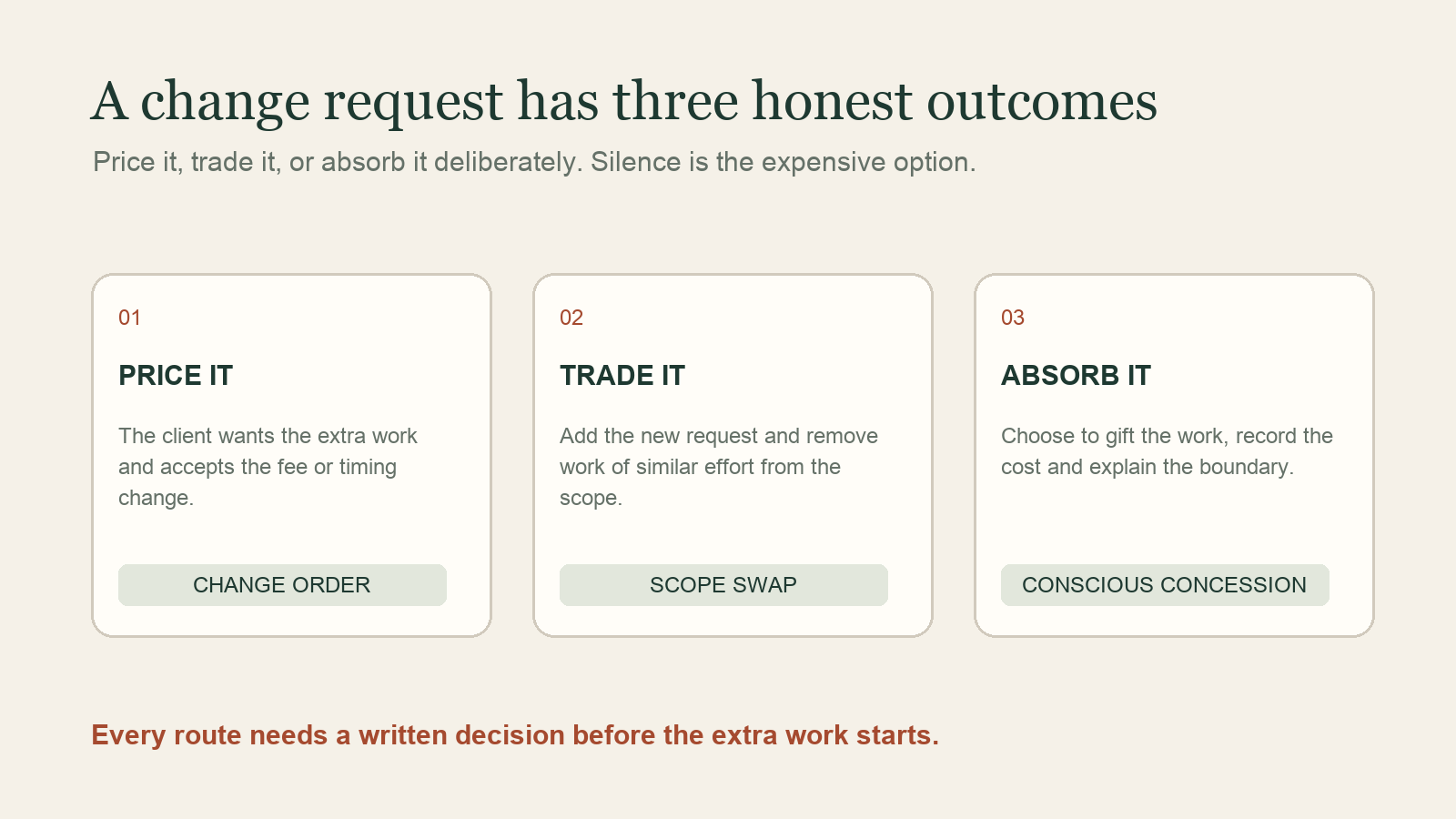
Price it, trade it, or absorb it.
There is no universal threshold that makes one route correct. The size of the request matters, but so do the relationship, timing, precedent and the value of the wider engagement.
01
Price it
Use a change order when the client wants the additional outcome and is willing to adjust the commercial agreement or schedule.
“Happy to add this. It sits outside the agreed scope, so I’ll send the fee and timing impact for approval before we start.”
02
Trade it
Keep the fee stable by removing or deferring work of comparable effort. The client gets a choice instead of an unspoken overrun.
“We can fit this into the current fee if we swap out part of the agreed work. Let’s choose what moves.”
03
Absorb it deliberately
A concession can be commercially sensible. Record the cost, name it as a one-off and decide who approved it.
“We’ll include this as a one-time concession. I’ll document it so the boundary remains clear for later work.”
BEFORE YOU PRICE IT
Work out what kind of request you received.
The agreed deliverable needs explanation.
No new output or material effort. Usually part of delivery, unless the agreement says otherwise.
The work does not meet the agreed acceptance criteria.
Fix the miss. Calling your own correction scope creep destroys trust.
The request adds an outcome, audience, format, revision round or decision.
Estimate the impact and use one of the three routes above.
The agreement does not say enough to classify it confidently.
Pause, compare interpretations and clarify the boundary in writing before work continues.
A LIGHTWEIGHT CHANGE PROCESS
Five steps. One written decision.
- Capture the request. Write down what is being added or changed.
- Compare it with the baseline. Point to the deliverables, limits and acceptance criteria already agreed.
- Estimate the impact. Include delivery, coordination, review and schedule effects.
- Choose the route. Price, trade or absorb it. Record who made the decision.
- Get approval before work starts. Update the plan and preserve the original agreement.
PMI describes change control as identifying, documenting, approving or rejecting modifications to deliverables or project baselines.[1] Its guidance also stresses that approved expansion is a scope change, not scope creep.[2]
COMMON TRAPS
Pricing only the visible task
“Two extra slides” may also create another review, stakeholder call and round of edits. Estimate the whole change path.
Using the calculator as a weapon
The output is not proof that the client behaved badly. It shows the commercial effect of one scenario.
Calling every favour a leak
A deliberate concession is not a mistake. The problem is making concessions accidentally and repeatedly.
Starting while approval is pending
Once the work is delivered, the commercial decision becomes harder. Pause before the extra hours are spent.
WHAT THIS TOOL CANNOT KNOW
Margin is one input to the decision.
The calculator assumes the original project would otherwise finish within its planned hours. It values extra work using the internal cost and pricing assumptions you enter. It does not account for tax, cash flow, subcontractor minimums, legal rights, collection risk or the value of future work.
Check the actual agreement before treating any request as out of scope. If the wording is ambiguous or the relationship is disputed, get appropriate commercial or legal advice.
SOURCES
FROM AGREEMENT TO DELIVERY
Keep the decision attached to the work.
Practice helps consulting firms turn client evidence, recommendations and delivery decisions into a repeatable workflow.
Try Practice