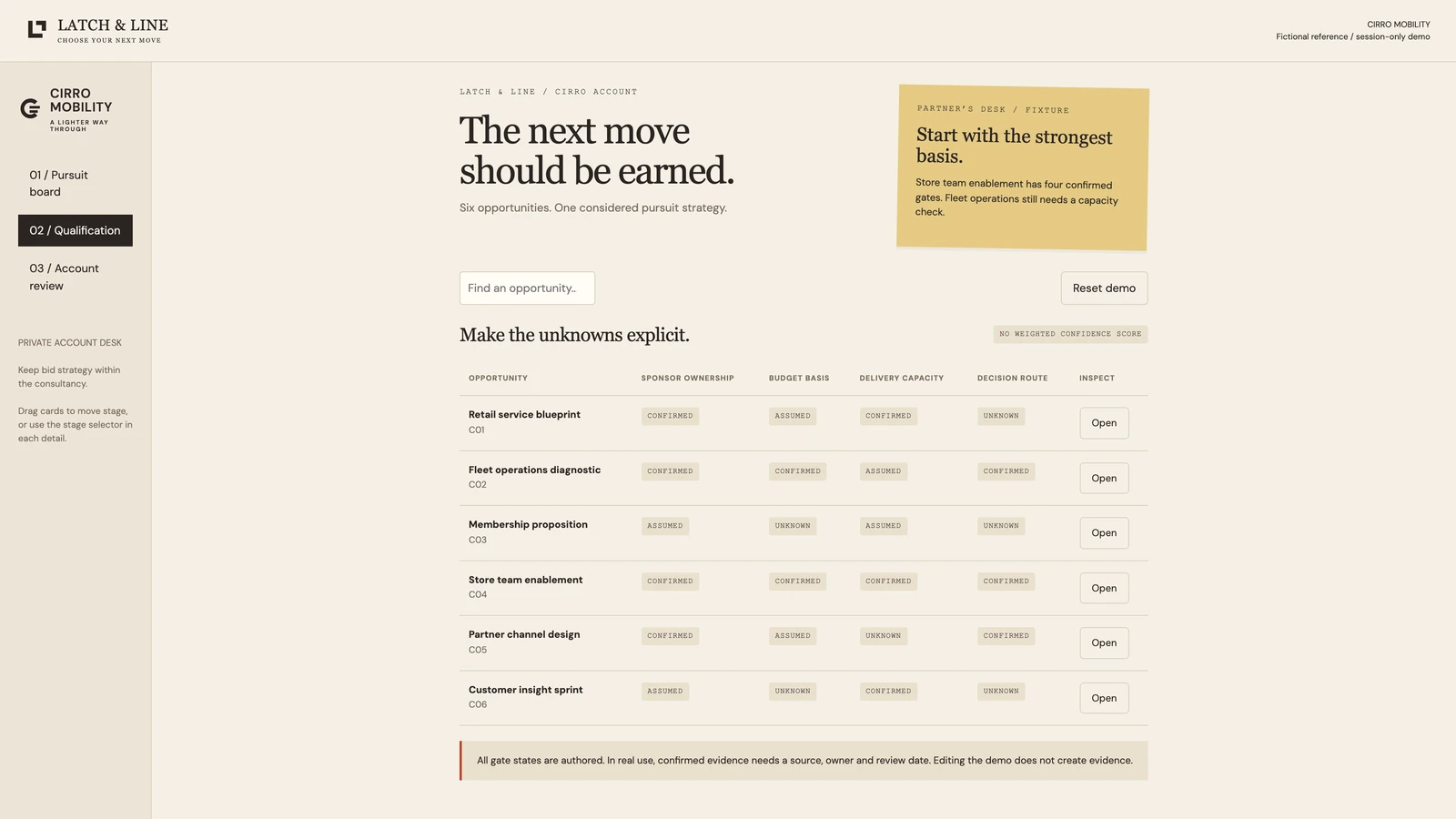
Store team enablement
Sponsor, budget basis, delivery capacity and decision route are confirmed in the example. Prepare a bounded approach and agree the next client discussion.
Consulting discovery questions
Run a discovery call that gives you a clear next step and enough evidence to explain it.
The first conversation
Open each question for the evidence to ask for and the decision it can help you make.
Ask for Ask for the decision date, the people involved and what happens if it slips.
Use it If the answer is a broad ambition, agree one decision worth examining before scoping the work.
Ask for Ask for one recent case, the people involved and a record the client can share.
Use it Use the case to distinguish an isolated problem from something you should test across a sample.
Ask for Name the sponsor, the funding owner and the person responsible for implementation.
Use it If ownership is unclear, agree who needs to join the next conversation.
Ask for Identify available people, records, approvals and specialist time.
Use it Scope around what you can actually examine. If access is uncertain, make resolving it the next step.
Ask for Capture the decision, deliverable and evidence standard the client would accept.
Use it Turn the answer into a short scope with an owner, a date and an explicit decision at the end.
Worked example
Sponsor, budget basis, delivery capacity and decision route are confirmed in the example. Prepare a bounded approach and agree the next client discussion.
Specialist availability remains open. Confirm capacity before committing to an approach or a start date.
Start with ownership and funding. Ask who will use the findings and what decision they need to make.
From call to scope
A qualification call helps both sides decide whether to proceed. Use paid discovery when reaching a defensible answer requires interviews, data review or options analysis. Agree the outputs, access, fee and decision date before starting.
A useful follow-up fits in a few lines. Confirm the decision, state what you still need to learn, and name who owns the next action. Where there is no clear fit, explain what would need to change or close the conversation.
Get the editable call and scope briefUseful answers
Review the client’s stated goal, context and likely decision makers. Bring a hypothesis and a few concrete questions that could change it.
An agreed question, evidence reviewed, findings and gaps, options or a next test, and a decision the client can make. Name the expected access and deliverable before agreeing the fee.