Opportunity audit
Where might a change create value? Examine tasks, exceptions, evidence and plausible interventions within a defined process.
Evidence before automation
An AI opportunity audit examines a business process, separates its problems from possible technologies, and identifies what is worth testing next.
The output should be a defensible decision—not a long list of things that could be automated. Start with the work, establish the evidence and make any investment conditional on what remains to be proved.
The first distinction
Missing ownership, inconsistent records and unclear rules can make work slow without making it suitable for AI. An audit should compare process fixes, rules-based automation and AI assistance before recommending a route.
Where might a change create value? Examine tasks, exceptions, evidence and plausible interventions within a defined process.
Can the organisation support the proposed change? Review data, ownership, skills and operating conditions. Readiness is necessary context, not proof of value.
Does the intervention meet the agreed standard on representative cases? Test the hypothesis with a baseline, independent answers and explicit stop conditions.
Worked example · order intake to dispatch
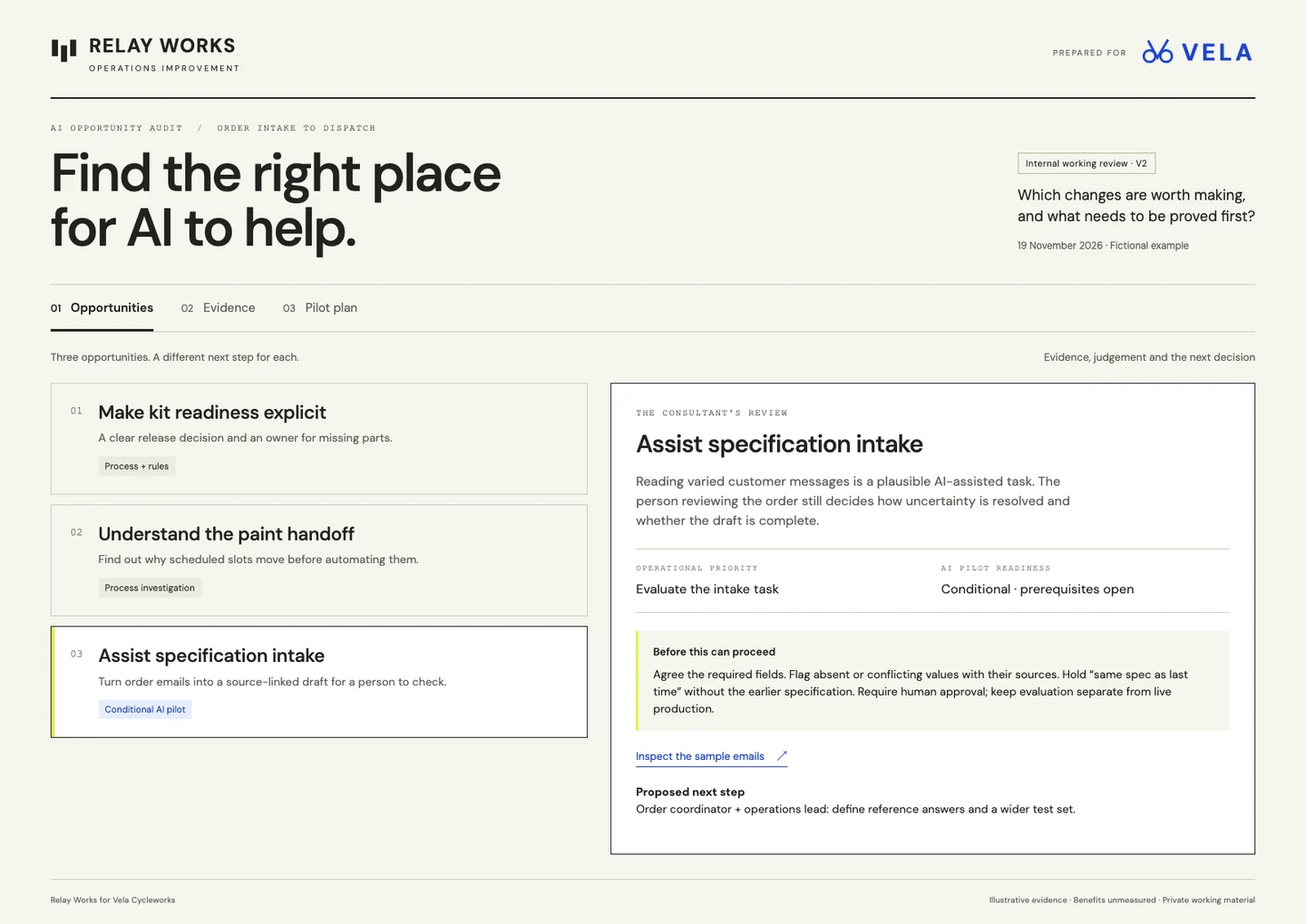
The Vela example combines a sample order dataset, process notes and a separate set of sample emails. Explore how each input informs the audit.
Thirty-five synthetic orders carry a kit-shortage label, and the scenario notes lack a consistent shared readiness record. That is a reason to inspect release discipline, not proof of a root cause. The recommendation is to define a release check and name an owner for missing-item follow-up.
What must be verified: the real release sequence and shortage records. Making the status visible does not itself remove a shortage or establish a reduction in lead time.
The notes do not explain consistently why paint slots change. Capacity calendars and event history are absent. Recommending an optimisation engine at this point would skip the evidence needed to understand the constraint.
What must be verified: schedule-change reasons, decision ownership and sequence constraints. Observe the work and capture these inputs before selecting a technology.
The example emails contain missing context and conflicting values between messages and attachments. An AI-assisted draft could help organise required fields, provided each value points to its source and unresolved details are held for human clarification.
What must be verified: the required fields, permitted values, reviewer, exception rules and an independent evaluation set. The six demonstration emails are discussion examples, not a representative performance benchmark.
Run the assessment
A high total can conceal a critical weakness. Keep risk and permission checks as explicit gates rather than letting an attractive value estimate cancel them out.
Agree where it starts and ends, which teams and cases are included, who sponsors the work and which decision the audit supports. “AI across the business” is too broad for a focused assessment.
Map steps, handoffs, systems and exceptions. Collect permitted evidence from records and people who do the work. Label observation, measurement, opinion and assumption separately. Include failed and incomplete cases where relevant rather than relying only on completed work.
Record volumes, handling effort, waiting time, error patterns and rework with their definitions and sample limits. Do not convert waiting time directly into labour savings. Identify which costs would actually change and what the intervention would cost to operate.
Consider a clearer rule, better ownership, a simpler form, conventional automation and AI assistance. For each, state the hypothesis, evidence, missing inputs, implementation dependencies and failure consequences.
Recommend a process fix, further investigation, a bounded pilot or no action. Give it an owner and a review date. An audit can be useful when it rules out an attractive but unsupported idea.
A pilot that can say no
For the Vela intake idea, the first test stays separate from live production. It uses permitted sample inputs, human review and no autonomous order release, customer commitments or system writes.
Have a knowledgeable reviewer establish the reference values independently. Include missing information, conflicting attachments and multiple order lines. Keep an evaluation set separate from examples used to shape the approach.
Check correct fields, missed exceptions, unnecessary flags, reviewer effort and resulting rework. Compare against manual handling on a comparable set. Fast generation alone is not evidence of a better process.
Agree acceptance thresholds and stop conditions before running the test. Review failures by case type. Decide whether to stop, refine or proceed, with named ownership for any next-stage risks.
Practice can help organise the source material and develop the assessment artefact. The consultant still needs to validate the evidence, challenge the recommendation and agree the pilot with the client.
An assessment worksheet covering evidence, alternatives, feasibility, risk and a pilot decision.
Editable plain-text worksheet · no email required
Useful answers
A bounded process assessment, an evidence register, a comparison of interventions and a recommended next decision. A worthwhile deliverable explains both why an opportunity deserves attention and what remains unproven.
Compare plausible value, evidence quality, feasibility and implementation effort. Treat material permission, safety and ownership gaps as gates. Keep the reasoning visible instead of relying on a single weighted score.
No. Vela is fictional and the evidence is illustrative. The recommendation explicitly leaves financial savings unestimated until handling effort, costs and implementation requirements have a reliable baseline. It proposes a test rather than claiming a result.