The client response
What happens today?
600 orders in four weeks. A 30-order timing sample averages ten minutes, including rework.
Example evidence E01–E03: order count, timing sample and correction log.
Assessment software for consultants
Build a branded assessment around the decision your client needs to make.
Collect structured responses, keep assumptions visible and use the evidence to shape the recommendation. A useful assessment explains more than a score: it shows what you know, what is estimated and what still needs checking.
From response to recommendation
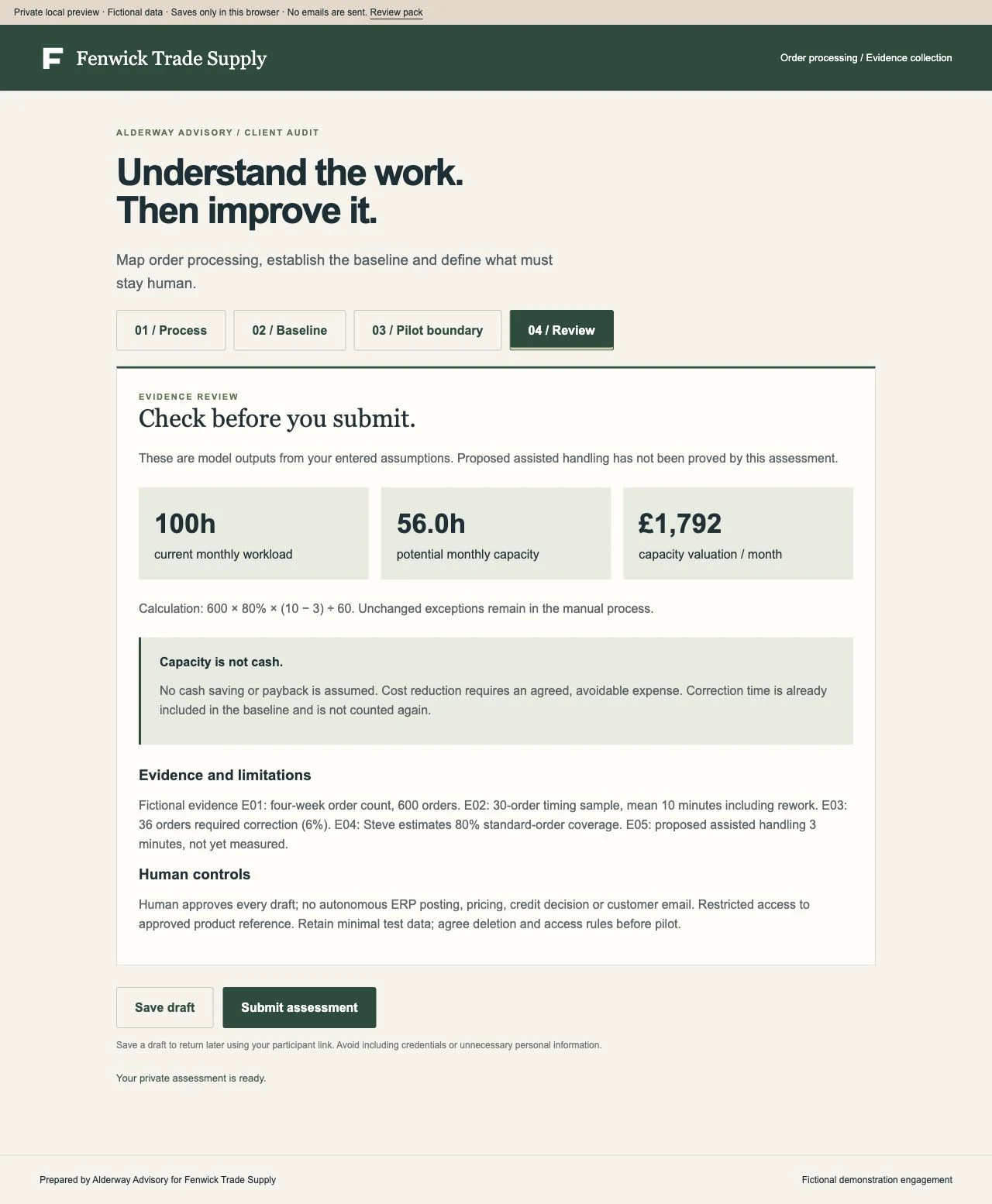
Fenwick’s assessment concerns one order-processing workflow. Explore how the baseline, coverage assumption and human controls support different parts of the consultant’s recommendation.
The client response
600 orders in four weeks. A 30-order timing sample averages ten minutes, including rework.
Example evidence E01–E03: order count, timing sample and correction log.
The consulting interpretation
100 hours of current monthly handling work. The 6% correction rate is already reflected in the observed handling time; do not add it again.
Alderway × Fenwick · example assessment
Design the assessment
Begin with the decision, the respondent and the evidence you need. An operations lead may know the normal process but only estimate volumes. A finance owner may be better placed to confirm the cost basis. Ask each person for information they can reasonably support.
Use a defined period, unit and source wherever a response will enter a calculation. Offer a way to identify missing evidence. An unanswered question and a measured zero have different meanings.
A more useful question
“How long does one standard order take to process, including corrections?”
From question set to client work
Practice supports participant-based assessment experiences. Choose the response and sharing settings for the specific assessment, then check the participant journey before inviting the client.
Define the questions, supporting instructions and response structure. Use your firm’s branding and keep the purpose clear.
Review who can respond and whether submissions can be edited. Keep private client assessments separate from public acquisition tools.
Distinguish an invitation, a started draft and a submitted response. Check the latest submitted evidence before drawing conclusions.
Turn the findings into a decision, its assumptions and a bounded next step. Review the report before sharing it with the client.
The interpretation matters
In the Fenwick example, the proposed handling time creates a calculated opportunity of 56 hours per month. That calculation depends on an estimated 80% standard-order coverage and a three-minute assisted handling time that has not yet been measured.
The recommendation is therefore a controlled pilot with human review. The pilot measures handling time and checks integration requirements before the team decides what to expand.
A recommendation worth making
Test the standard path.
Keep exceptions manual.
Measure before expanding.
Use a private assessment when the questions concern an agreed engagement, internal evidence or named participants. Explain access and intended use before requesting responses.
Keep each participant’s response attributable within the chosen access model. Disagreement can reveal different operating conditions; do not hide it inside an unexplained average.
A public diagnostic serves a different purpose: helping a prospect understand a problem and choose a next step. Give it its own questions, result and consent choices.
Explore consulting funnelsUseful answers
Practice has participant-based artefacts and assessment workflows for collecting structured client input. The exact response controls depend on the assessment configuration. Review the published participant experience and access settings before inviting real respondents.
No. Record whether each important input is observed, estimated or proposed. Check the source, sample and period before using it to support a recommendation.
Built around your expertise
Shape an assessment around the evidence your next recommendation needs.