Executive summary
The recommendation, the decision required and the most important condition. Write this after the analysis; place it first.
The consulting field guide / Reporting
A useful structure. A complete worked example. And the reasoning behind every section.
Use this consulting report template to turn analysis into a recommendation your client can inspect, challenge and act on. Start with the question, then earn the conclusion.
The recommendation, the decision required and the most important condition. Write this after the analysis; place it first.
The question you were asked, the boundaries of the review, the sources used and the gaps that remain.
What you found, the evidence for it and why it matters. Distinguish an observed fact from an interpretation.
Credible alternatives, consistent comparison criteria, your preferred course and the trade-offs it involves.
The expected implications, supporting calculations, assumptions and the conditions that could change the answer.
Actions, owners, dependencies, review dates and any approval the client must give.
Detailed calculations, references, definitions and supporting material that would interrupt the main argument.
A report, with the thinking in the margin
In this example capacity review, Northline compares investment options for Aster. Explore six parts of the argument and use the writing prompts to shape your own report.
Reading the example / Recommendation
A busy sponsor should know what you recommend, what it costs and what remains conditional without reconstructing the analysis.
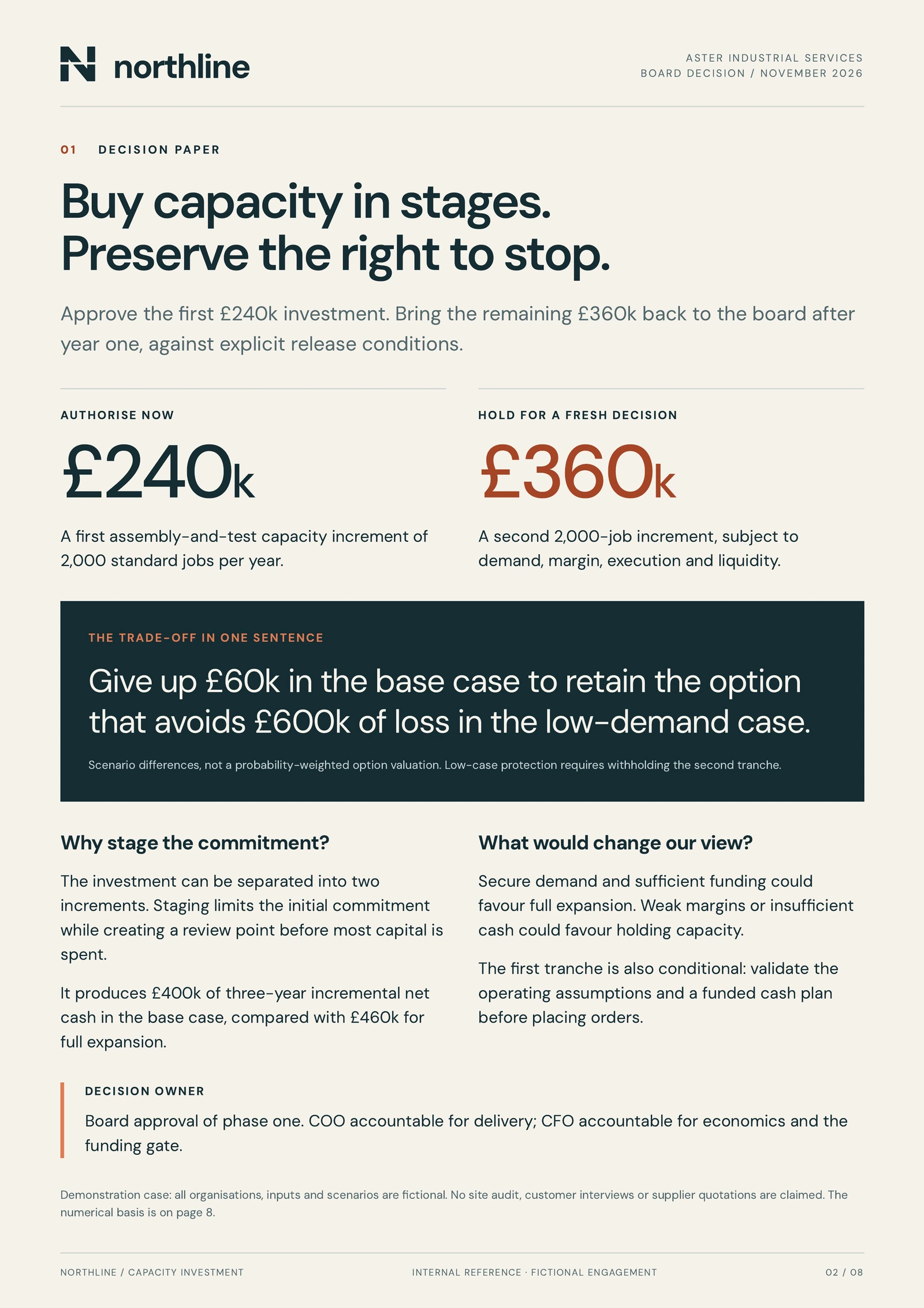
The example separates a £240,000 first commitment from a possible £360,000 second stage. That distinction prevents a staged recommendation being read as approval of the full investment.
We recommend [action], subject to [conditions]. The decision required now is [approval]. The later decision is [separate commitment].
Before you send itCould someone read only this page and still understand what they are being asked to approve?
The complete example includes the cover and numerical assumptions.
Choose the shape of the answer
Keep the logic consistent while changing the emphasis. The client’s decision should determine the report format, not the availability of a familiar slide deck.
Lead with the choice and approval required. Bring alternatives, financial implications and decision conditions forward. Put detailed workings in an appendix.
Opening question: What are we being asked to commit to, and what would make it a poor decision?
Lead with the observed problem and evidence. Show the difference between a symptom and a suspected cause. Identify which hypotheses still need testing.
Opening question: What is happening, what explains it, and what can we check next?
Lead with priorities, owners and dependencies. Explain the rationale for each action and how progress will be reviewed. Make unresolved decisions visible.
Opening question: Who needs to do what, in which order, and how will we know it is working?
The final editorial pass
Strong wording makes the reasoning easier to assess. It does not turn an assumption into a fact.
Too vague
“We recommend investing in additional capacity to unlock significant growth.”
The reader cannot tell how much to approve, which evidence supports the benefit or what must happen first.
More decision-ready
“Approve the first £240,000 stage subject to validation. Return the possible £360,000 second stage for a separate decision against the agreed gates.”
The illustrative recommendation distinguishes the commitment now from the decision later. The supporting analysis must still justify it.
Put the structure to work
In Practice, bring the client brief, source material and your method into the conversation. Ask for a draft, refine specific sections and check the output before sharing. This guide’s outline is a starting brief; your evidence and judgement give the report substance.
See report writing in PracticeDownload the editable writing outline and a complete example PDF. Both are available without an account.
Get the reusable outlineUseful answers
Include the client question, scope, method, findings, supporting evidence, options, recommendation and next actions. Add assumptions and source details where the reader can inspect them. The seven-part structure above is a starting point; combine or expand sections to suit the decision.
Long enough to support the decision and explain material uncertainty. Use a concise main narrative with detailed workings in an appendix. The eight-page example is one format, not a required length.
No. A proposal defines the work you want a client to agree to. A report communicates the analysis, findings and recommendations from the work. They may share context, but serve different decisions.
Yes. Adapt the evidence, criteria and terminology to your engagement. A change consultant may emphasise affected groups and readiness, while an operations consultant may emphasise process evidence and constraints. Use the figures and assumptions from your own engagement.