Customer journey mapping
See the journey.
Fix the handoff.
Map what customers do, where they get stuck and what your team can change.
Follow a passenger journey from planning to arrival, then use the editable customer journey map template to trace a service of your own.
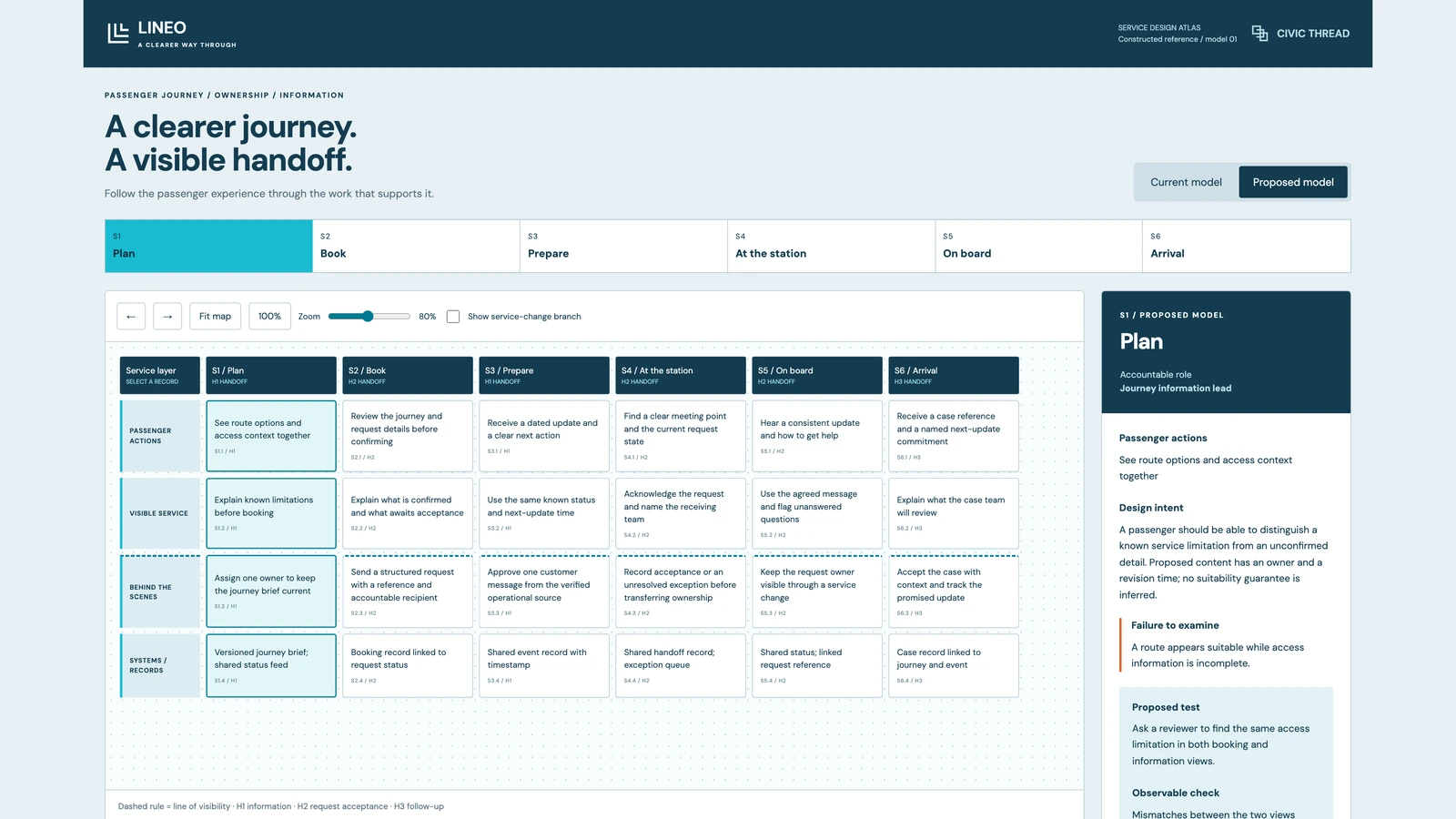
Interactive example
One trip.
Six stages.
Switch between the current and proposed models. Select At the station to see how a passenger’s request moves from a booking to a receiving team, and what the team could measure when it changes that handoff.
Open the atlas in a new tabDownload the example blueprint PDF
From friction to a test
Make the next step
someone’s job.
In the Lineo example, a passenger reaches the station and has to explain their assistance request again. The journey map shows the moment of friction. The service blueprint traces it back to a booking record, a separate request queue and a manual handoff.
- What the passenger needs
- A clear meeting point and confirmation of who is picking up the request.
- What to change
- Give the receiving team the request status and a way to acknowledge ownership before the passenger arrives.
- What to measure
- Track the share of sampled requests staff can locate without asking passengers to repeat their details. Compare equivalent service windows before and during the pilot.
Use the template
Build your own
customer journey map.
Use one row per stage or touchpoint. Start with the customer’s goal and your evidence, then add the handoff, owner and proposed test. Download the CSV template
Define one journey
Choose a customer group, the outcome they need and a clear start and end. For a passenger requesting assistance, that might run from checking whether a journey is accessible to getting an answer after arrival.
Work from evidence
Use interviews, observations and service records to capture what happened. Record the date, channel and evidence reference at each touchpoint. If different groups take materially different routes, map them separately.
Find where context gets lost
Look for repeated requests, missed updates and unclear ownership. Add the team, system or queue behind the interaction so you can identify the handoff that needs attention.
Choose a change to test
Compare frequency and impact, then pick a change with a named owner. Record the baseline, the test window and the measure before you call the change an improvement.
Further reading: GOV.UK Service Manual on experience mapping.
Useful answers
Before you
begin.
What is a customer journey map?
A customer journey map shows the steps someone takes to reach a goal, what they need at each point and where the service creates friction.
What is the difference between a journey map and a service blueprint?
A journey map follows the customer’s experience. A service blueprint adds the staff, systems and backstage work that deliver each step. Use the blueprint when resolving the problem depends on a handoff or process change.
How should I prioritise improvements?
Compare how often the problem occurs, how much it affects the customer and what it will take to change. Use a defined baseline and a short test to check whether the proposed change helps.