Inputs the reader understands.
A product family and a market have explicit definitions. Optional research and enablement are separate choices.
Interactive consulting deliverables
A useful deliverable can respond when the assumptions change.
Build around a real choice: scope, cost, capacity or timing. Let the reader change a meaningful input, see the result and inspect how the model gets there.
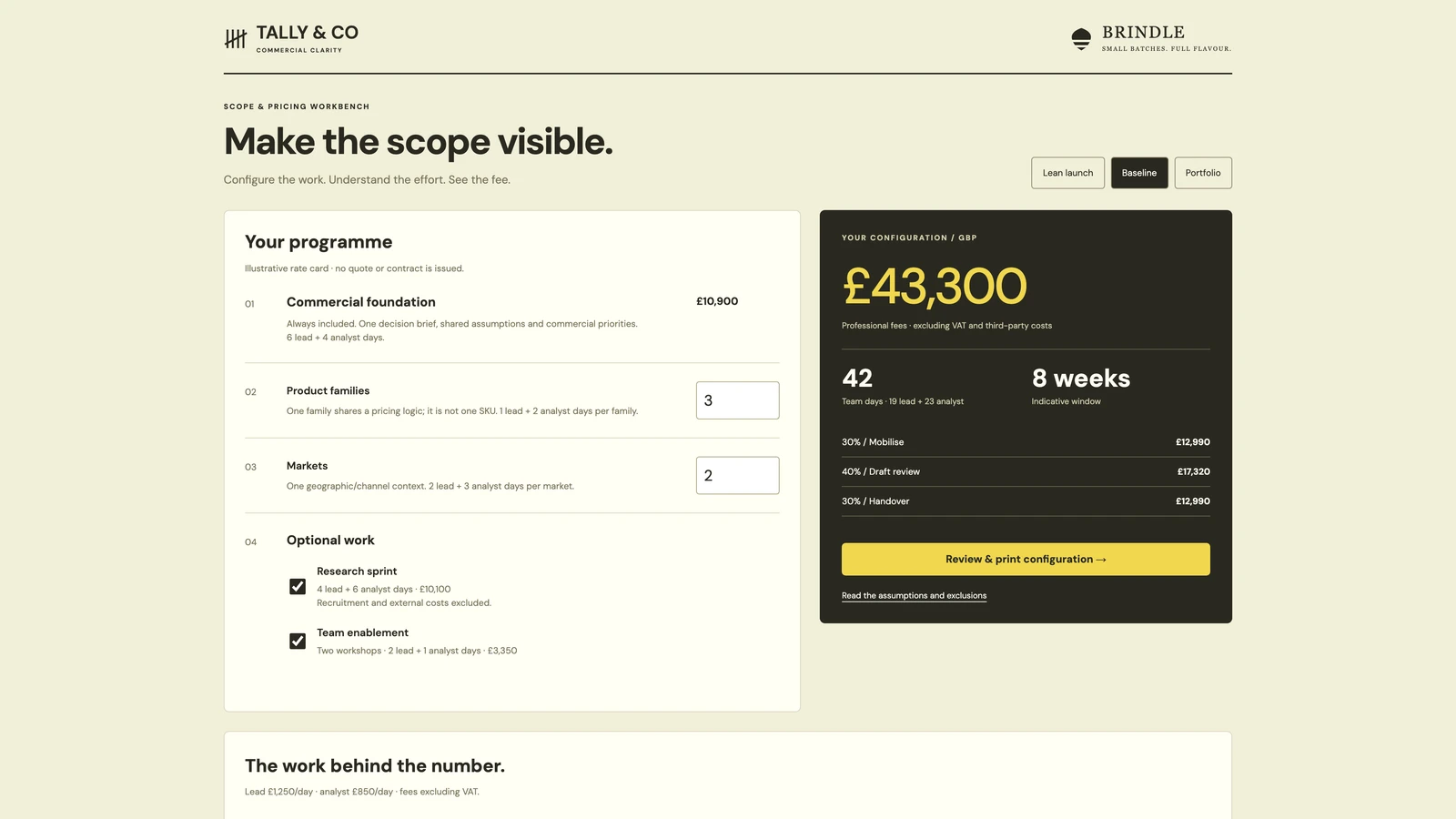
Change the scope
Start with three product families and two markets. Remove the research sprint and inspect what changes: the fee, effort, indicative window and payment stages. Then consider whether the remaining evidence is enough for the assignment.
Choose the breadth of the pricing work and the support included.
A family shares one pricing logic; a market is one geographic or channel context. These are illustrative effort assumptions, not Practice subscription prices.
Illustrative professional fee
£43,300Excluding VAT and third-party costs19 lead days at £1,250 + 23 analyst days at £850.
The research sprint is included.
| Work package | Quantity | Lead days | Analyst days | Fee |
|---|---|---|---|---|
| Commercial foundation | 1 | 6 | 4 | £10,900 |
| Product-family architecture | 3 | 3 | 6 | £8,850 |
| Market adaptation | 2 | 4 | 6 | £10,100 |
| Research sprint | 1 | 4 | 6 | £10,100 |
| Team enablement | 1 | 2 | 1 | £3,350 |
The window is 42 team days ÷ seven available team days per week, rounded up, plus two review weeks. It is an effort-based estimate, not a resource-levelled calendar or agreed deadline.
Adapted from the existing Tally portfolio model with the same effort and pricing assumptions. The controls calculate locally; they do not issue a quote, update a contract or demonstrate a live AI generation.
Make the implication explicit
At the original quantities, removing research changes the fee from £43,300 to £33,200. It removes four lead days and six analyst days, taking the effort from 42 to 32 team days.
The model’s indicative window changes from eight weeks to seven. That estimate assumes seven team days of capacity each week plus two review weeks. It is not a committed delivery date.
The commercial decision is more than the lower number: what evidence will support the work when the research sprint is excluded?
A product family and a market have explicit definitions. Optional research and enablement are separate choices.
Work packages translate into lead and analyst effort. Stated day rates produce the fee; capacity assumptions produce the indicative window.
Choose the right form
Interactivity earns its place when it makes a trade-off easier to understand. The input should affect something material, and the reader should be able to explain the result.
Compare included work, effort and commercial stages before preparing an agreed proposal.
Explore demand and effort assumptions, identify the limiting resource and show what must change.
Separate cash effects from capacity value. Change adoption or timing and inspect the implications before recommending a decision.
Build and review in Practice
Give Practice the client’s decision, the permitted source material and the relationships the model should represent. Review the generated artefact’s logic and behaviour before sharing it. Explore a worked customer journey map.
Name the audience, the choices they can influence and the output they need. Keep decorative controls out of the brief.
Identify editable inputs, fixed source facts, units and valid ranges. Explain what an estimate leaves out.
Calculate a known case independently. Test a changed input, a boundary value and an invalid value. Ensure related totals move together.
Explain how to use the model, what persists and what is only a local scenario. Test the sharing and export experience separately.
The downloadable Tally proposal records the original scope. It does not update when you change the controls on this page. A static PDF cannot preserve every interactive behaviour; review the format your client will actually receive.
Inspect the original work
The original portfolio app contains the fuller workbench and a configuration review. The baseline proposal is a separate static reference, with scope and commercial assumptions.
A client question worth answering
“If we remove the research sprint, what changes—and what would we need to supply ourselves?”
The model explains the numbers. The consultant still needs to explain the consequence.
Useful answers
It is a client-facing tool that responds to meaningful inputs: for example, a scope calculator, scenario model or decision aid. It should make assumptions and trade-offs easier to inspect, with a clear boundary around what its outputs mean.
No. The PDF is the static baseline proposal. The interactive configuration has its own current result. Keep exported documents and live model states clearly labelled.
Do not assume so. Browser interactions, static exports and editable Office formats have different capabilities. Verify the required output format and its fidelity for the specific deliverable.
Your expertise, put to work
Bring a decision, your source material and a clear review standard to the work.