£8,640
Original example invoice, including illustrative VAT.
Overdue invoice reminder emails for consultants
An overdue invoice, a payment promise and a disputed fee are different conversations.
Before chasing payment, check what is actually outstanding and whether anything has changed. Use the worked examples to write a clear reminder, respond to a missed promise or resolve a specific query.
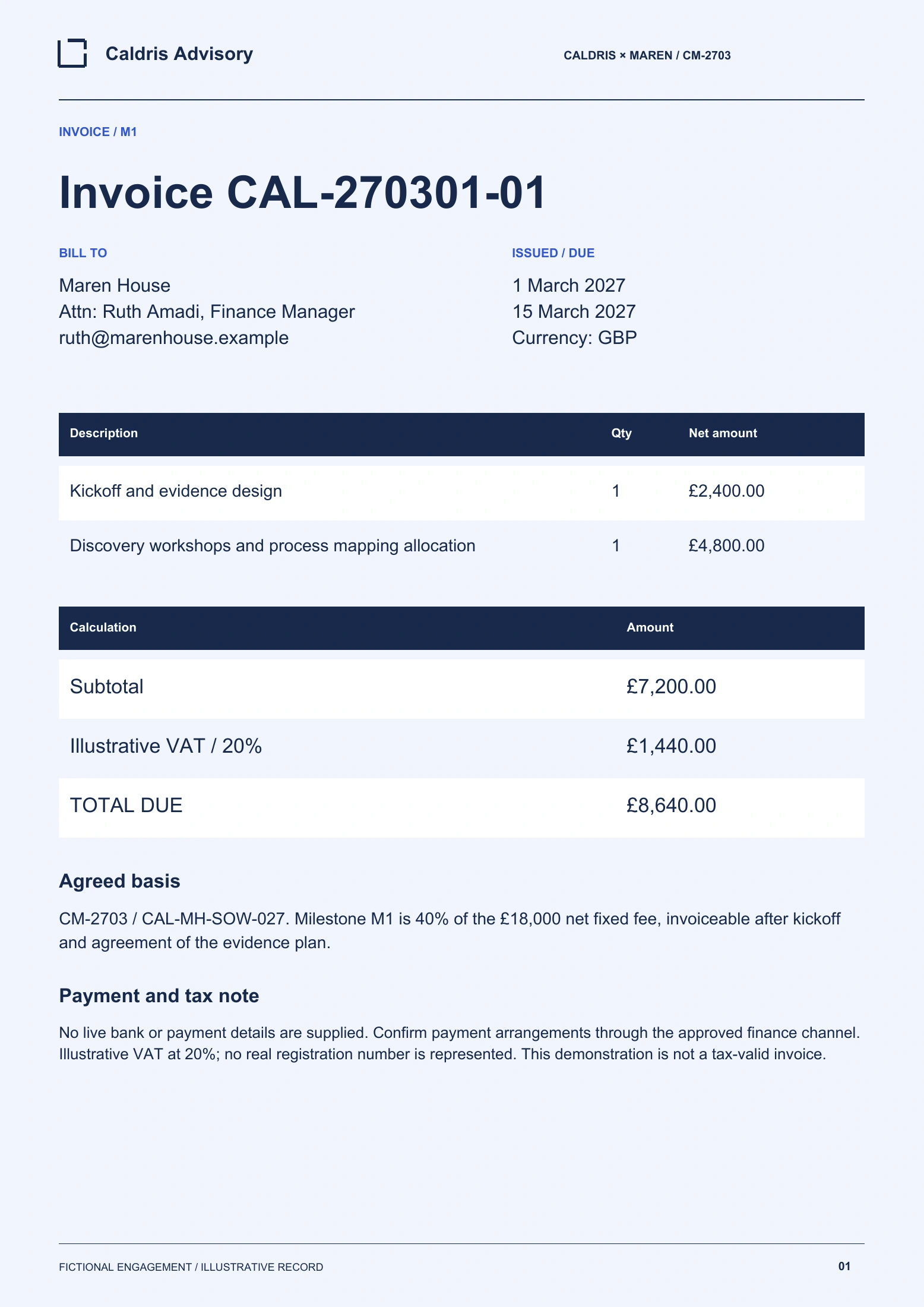
Original example invoice, including illustrative VAT.
Agreed due date in the example engagement.
The client’s finance contact in the example.
Before the first reminder
A reminder should identify the invoice, due date, current outstanding amount and the response you need. That amount must reflect confirmed payments and approved credits, not the original total by default.
The Caldris example concerns the first milestone of a larger engagement. Resolving this invoice does not establish whether any other invoice has been paid.
Look for a matched receipt and any unapplied payment before saying that nothing has been received.
Read the latest finance reply. A dispute or revised promise changes the appropriate next step.
Confirm the finance contact, invoice number, due date, currency and attachment.
Request confirmation of payment timing, remittance information or the exact item being queried.
A worked payment history
In one history, a promised payment is late. In the other, written input replaces a workshop and the parties agree a credit. Select a history and date to inspect the balance and correspondence.
Two alternative histories for the same example invoice. They must not be combined.
Outstanding at this point
£8,64016 Mar 2027 · CAL-270301-01First reminder authored; no delivery or read receipt
Illustrative figures including assumed VAT. A promise does not reduce the balance; an agreed credit and a payment do.
Choose the response
These examples illustrate communication and record checking. They do not set a universal collection timetable or establish entitlement to interest, charges or legal action.
State the due date and current balance, reattach the invoice where helpful and ask when payment is expected. Offer to resolve a missing reference or approval issue.
Confirm what was agreed and the reconciliation cutoff. Ask whether payment has been made and request remittance details, or agree a revised date.
Check the scope and delivery evidence. In this example an approved credit reduces the balance; the remaining payment is then recorded separately.
A promise is not a receipt
In the late-payment history, the 24 March promise leaves £8,640 outstanding. The balance reaches zero only when the example records a matched £8,640 payment on 30 March.
In the alternative dispute history, an agreed £1,440 credit reduces the balance to £7,200 on 19 March. A separate £7,200 payment clears it on 23 March. Combining these histories would produce an incorrect account.
Once the relevant balance is reconciled, stop reminders for that invoice and confirm the resolution. Keep any remaining engagement obligations separate.
Read the supporting records
Explore the invoices and correspondence behind both payment histories.
Use the context in Practice
Keep the invoice reference, client context and latest correspondence in view when preparing your draft. Review the amount and recipient before sending.
Open the separate Practice invoice demonstration to explore its document and status views. No invoice is issued and no payment is collected from the preview.
Useful answers
Include the invoice reference, due date, current outstanding amount and a clear request for payment timing or clarification. Check payments, approved credits and the latest correspondence before using the figure.
Ask for the payment date and remittance reference, then check for the receipt and any unapplied amount. Do not treat the statement alone as a matched payment, but avoid repeating an unchanged reminder while checking it.
Identify the specific line or scope issue, review the supporting records and agree the appropriate next step. Keep any approved credit distinct from a payment. The worked example illustrates one negotiated resolution, not a universal legal rule.
Bring the work together
Keep the work, invoice and client correspondence connected, with a deliberate review before the next action.