Compare what the role needs with what the evidence shows.
A skills gap analysis should lead to a useful response: practice, coaching, a better process or a clearer question. Start with observable tasks so a confidence score does not become a substitute for performance.
Steady State × Helio Works · example operations playbook
What is a skills gap analysis?
A requirement. An observation. A response.
A skills gap analysis compares the capability needed for a defined role or task with the capability supported by current evidence. The useful gap is specific: what must someone be able to do, in which conditions, and what remains unproven?
Begin with the work the organisation needs now or is preparing to introduce. Agree the required standard with the people accountable for it. Then collect evidence that fits the task, such as a reviewed work sample, a scenario or an observed walkthrough.
Keep self-assessment as one perspective. It can reveal confidence or learning needs, but it cannot by itself establish that a task is performed reliably. A missing observation is an evidence gap, not a measured lack of ability.
Helio Works · coordination practice
Three gaps. Three different responses.
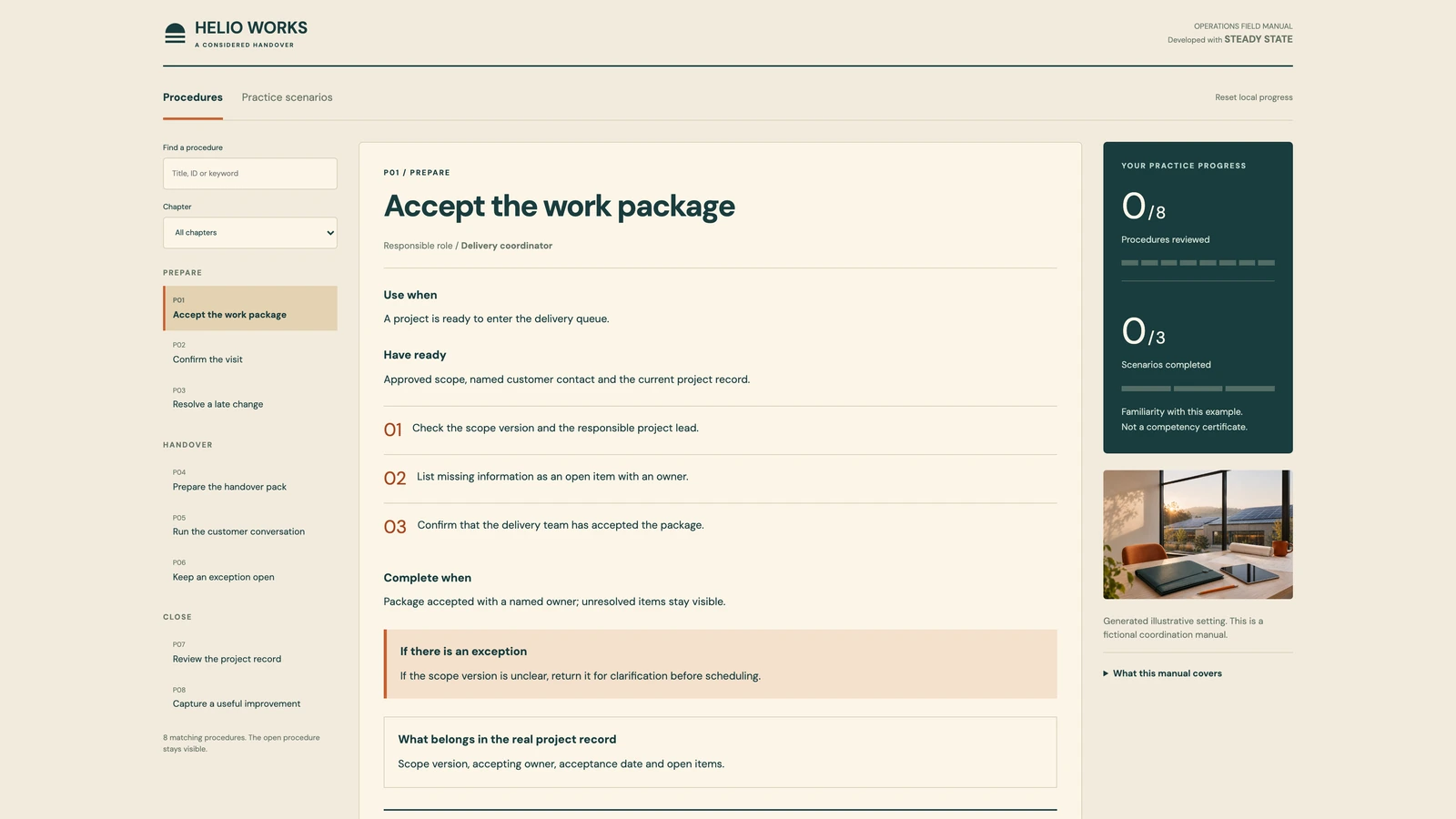
Explore three situations from Helio’s coordination work: accepting a package, keeping an exception open and preparing a handover.
P01 · delivery coordinatorA practice gap
Required performance
Check the current scope, name the accepting owner and record open items before scheduling.
Evidence available
In this example, the coordinator finds the scope but omits the accepting owner and one unresolved item.
A proportionate response
Use a worked package with an ambiguous version and a missing input. Coach the coordinator to record both the owner and open item.
How to check it helped
A later observed walkthrough handles a fresh package and explains when to return it for clarification.
Build a defensible comparison
Give the standard something you can observe.
“Good at handover” is difficult to assess consistently. Break the work into meaningful tasks and describe successful performance, including what to do when the normal path cannot continue.
Task
Required evidence
Insufficient on its own
Accept the work package
Correct scope version, accepting owner and unresolved items retained in the record.
Attendance at an introduction to the process.
Keep an exception open
A named owner, next update and authorised resolution evidence before closure.
A message confirming the issue was forwarded.
Prepare the handover pack
Required records checked, missing documents visible and technical questions routed correctly.
A self-rating of confidence with handovers.
Before choosing training
Can they do the task? Can the system let them?
Practice the judgement
If the required information and tools are available but a key step is missed, try a targeted scenario with feedback. Use a different example afterwards to see whether the person can apply the approach rather than remember the answer.
Remove the constraint
If a tracker cannot hold the required information, or responsibility is unresolved, fix the working conditions. Document the constraint and its owner. Do not label a tool or process failure as an individual skills deficit.
Gather the evidence
If the evidence is missing or contradictory, arrange a suitable observation before prescribing a remedy. Explain its purpose and give people a way to clarify context or challenge an inaccurate interpretation.
A practical skills gap template
Prioritise the consequence. Then plan the support.
Start with tasks that block the next stage of delivery or create repeated rework. Explain the priority using the task’s consequences, frequency and available evidence. A neat numerical average can conceal an important exception.
Task standards, evidence, diagnosis, actions and reassessment. Editable text template · no email required
Record the role, task, conditions and expected standard. Name the person who confirmed the requirement and its version. Include the boundaries of the role and the route for matters needing specialist judgement.
Record the current evidence
State the observation method, date, sample and assessor. Separate observed performance, self-report and unknowns. Use “not assessed” when evidence is absent; do not silently convert it to zero.
Choose the response
Explain whether the gap concerns skill, knowledge, practice, access, tools, capacity or unclear process. Set a proportionate action with an owner, required support and review date. Several causes may need attention together.
Reassess the work
Agree what successful performance will look like after the intervention. Check it using a relevant task and record remaining limitations. Course completion is an activity record; use in the working context needs separate evidence.
Steady State × Helio Works · complete operations playbook
A shared reference for practice
Make the right steps easy to revisit.
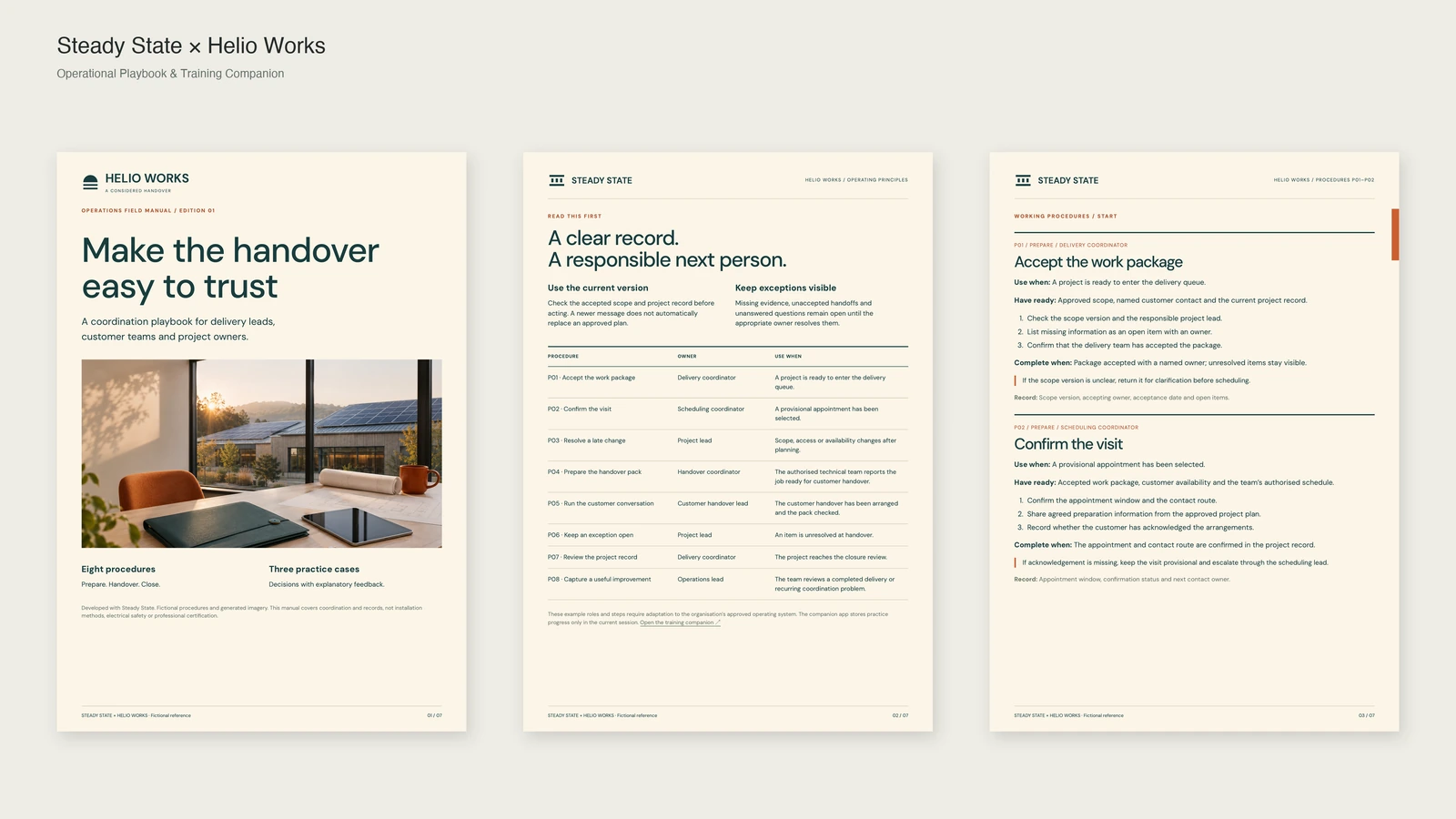
The Helio manual gives each procedure a trigger, inputs, steps, completion condition and exception route. That structure makes a useful reference when agreeing the requirement and designing a practice scenario.
Use the playbook to support practice, then follow up with a task walkthrough in the working environment.
First define a task and required standard. Compare that with current evidence. If you use a rating scale, define each level and use the same scale for current and required capability. Treat a difference as an ordering aid, not a precise measure of learning time or productivity.
Is skills gap analysis the same as training needs analysis?
They overlap. Skills gap analysis identifies the difference between required capability and current evidence. Training needs analysis considers which learning response is appropriate. Some gaps require better access, tools, role clarity or capacity instead of training.
Can I use a skills matrix?
Yes. A matrix can summarise tasks or capabilities by role, provided the standards and evidence behind each entry remain available. Keep unknown values distinct from low ratings and avoid using one aggregate score to hide a critical task gap.