A useful stakeholder map changes the next conversation.
Identify who can shape a decision, who will live with it and whose experience is missing. Turn that understanding into a specific engagement action, an owner and a way to learn.
Stakeholder analysis is a structured way to understand the people and groups connected to a piece of work: their interests, influence, exposure to change and role in decisions. Its output should help you decide who to involve, what to ask and how to respond.
Start with a bounded decision. “Who matters to the company?” produces an endless directory. “Who needs to shape the replenishment handoff before the next rollout wave?” gives the analysis a useful scope. Include people who experience the consequences even when they cannot approve the programme.
The map is a working interpretation. Validate it through conversations and observations, record uncertainty and revisit it when responsibilities or the proposed change shift.
Luma Grocer · replenishment handoff
One change. Four perspectives.
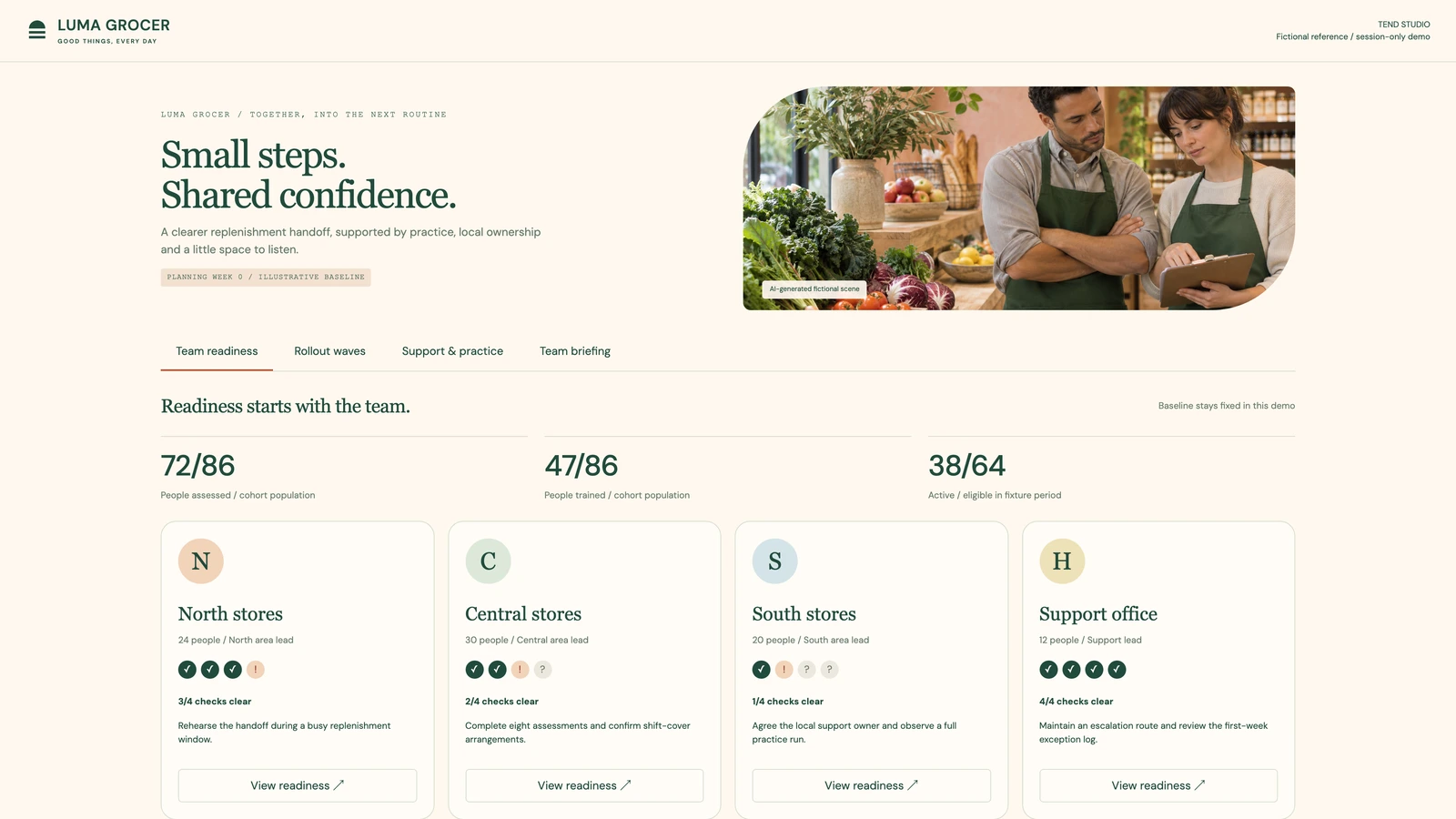
The portfolio identifies different readiness conditions across store cohorts and the support office. Select a stakeholder group to see how that evidence could inform a proposed engagement response.
A proposed engagement response
A handoff that works during a busy shift.
What the example tells us
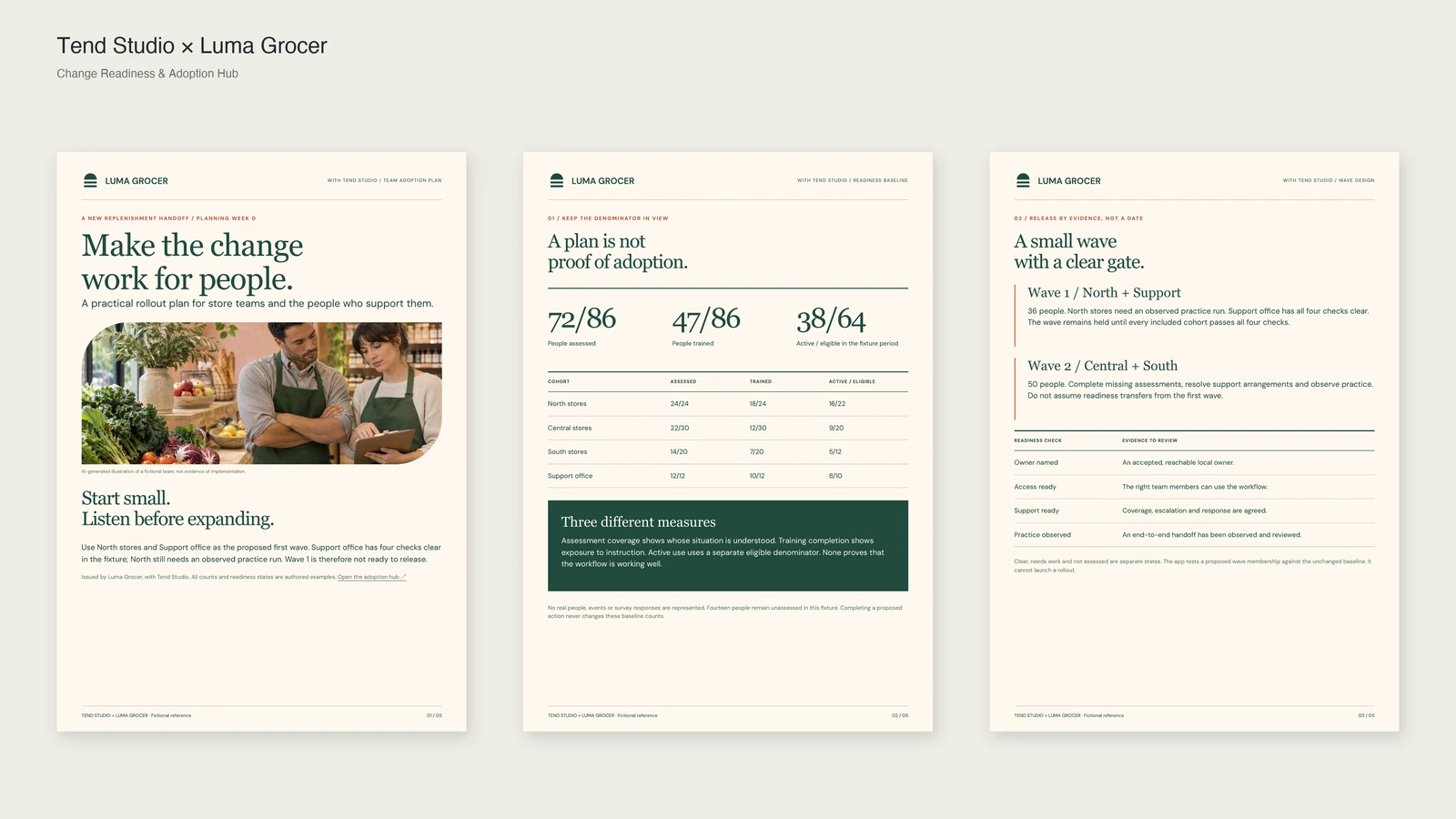
Central stores: 22 of 30 assessed. South stores: 14 of 20 assessed. Fourteen voices are still missing across the example baseline.
What we would do next
Invite the unassessed colleagues into short, shift-friendly conversations. Observe a handoff and record what prevents it working.
Proposed owner
Area leads
Evidence to look for
Missing perspectives recorded; practical barriers have a named owner.
Use the matrix carefully
Influence helps you plan. Impact helps you listen.
A power–interest matrix can organise an initial view. It should not become a reason to ignore people with less formal authority. Record practical impact, representation and access to the conversation alongside the matrix.
High influence. High interest.
Work closely on decisions, unresolved conditions and trade-offs.
High influence. Lower interest.
Agree which decisions need their attention and when to escalate.
Lower influence. High interest.
Create a reliable route to contribute, challenge and receive a response.
Lower influence. Lower interest.
Check the assessment is accurate. Keep a proportionate route to information and review.
Planning prompts, not labels for individual people. High impact can require active involvement in any quadrant.
The missing perspective
Fourteen people unassessed. Fourteen reasons to ask.
Look at coverage
Luma’s example baseline has 72 of 86 people assessed. Central accounts for eight missing assessments and South for six. The total identifies a coverage gap; it says nothing about why those people have not yet participated.
Change the invitation
A proposed response is to ask area leads for a practical way to hear from the missing colleagues. Consider shift patterns, access and whether a group conversation makes it easy to raise a difficult issue.
Close the loop
Record what was learned, which action changed and who will respond. An invitation sent is not participation. A completed assessment is not agreement with the change.
Keep the register proportionate and factual. Describe a concern in the stakeholder’s terms rather than assigning a personality label such as “resistant”. Separate their stated position from your interpretation.
Group, role and affected work
Record the decision in scope, the group’s relationship to it, the tasks that change and the way representatives were identified. A department name alone can hide different shifts, locations and responsibilities.
Evidence and uncertainty
Note the source and date of each material concern, influence judgement or dependency. Mark untested assumptions. Distinguish a decision-maker, an adviser and a person who will carry out the work.
Engagement and response
Name the purpose of the next conversation, its owner, timing and accessible channel. Include the decision or action that will follow, a feedback route and the event that triggers a review of the analysis.
A decision brief, stakeholder register and engagement-action outline. Editable text template · no email required
The Luma portfolio turns readiness gaps into practice, listening and support actions. Use the stakeholder analysis to decide whose input those actions need, then carry the agreed response into the change plan.
Include the decision in scope, affected groups, interests and impacts, influence and decision roles, evidence sources, uncertainties, and a specific engagement action with an owner. Add a review trigger so the analysis stays current.
What is the difference between stakeholder analysis and an engagement plan?
Analysis explains who is involved, how they are affected and what needs understanding. The engagement plan turns that interpretation into conversations, consultation, communications and decisions. Update each when the other reveals something new.
Should low-power stakeholders receive less attention?
Formal influence is only one consideration. People may have little authority but experience substantial consequences or hold essential operational knowledge. Consider impact and representation before choosing an engagement approach.