A logic model makes the programme easier to see. A theory of change makes its reasoning easier to test.
Use the same engagement to explore both. Make resources, activities and intended outcomes explicit, then examine why one step should lead to the next and what evidence would challenge that belief.
Resources, activity, delivery and intended results in one inspectable view.
Theory of change
Why should it work?
Mechanisms, assumptions, context and alternative explanations behind the pathway.
The useful distinction
Two perspectives. Not a rigid boundary.
A logic model commonly summarises the relationship between inputs, activities, outputs and outcomes. A theory of change explains the reasoning behind an intervention: how change is expected to happen, for whom, in which conditions and through which mechanisms.
The terms overlap in practice. A logic model can include assumptions and context; a theory of change can be drawn as a compact diagram. The name matters less than whether the model makes the intended pathway and its uncertainties available for challenge.
Use a concise model when the client needs a shared programme view. Develop the explanation further when the causal links are uncertain, the context is complex or the evaluation needs to distinguish plausible mechanisms from other influences.
Nemi Learning · one proposed pathway
Follow the chain. Inspect each link.
Explore a proposed learner-support pilot for Nemi. Select a stage to see how the activity, intended result and assumptions connect.
Theory of change · Activities
What has to be true?
Reducing administration could make room for earlier learner support.
An evaluation question
How would we check?
Observe how the workflow is used and whether released time is actually spent on follow-up.
Nemi Learning · example programme model
Use each view for its job
More than two names for a diagram.
Neither view proves that an intervention works. Both help make the design discussable and identify the evidence that would make a claim more credible.
Question
Logic-model emphasis
Theory-of-change emphasis
What will we do?
Resources, activities and deliverables within scope.
Why these actions fit the problem and the people affected.
What should change?
Near-term and longer-term intended outcomes.
Mechanisms that could connect the activity to those outcomes.
What could break the pathway?
Visible dependencies and missing links.
Assumptions, context, alternative explanations and unintended effects.
How will we learn?
Measures associated with each stage.
Questions and evidence that test the important causal claims.
Delivery is not the same as change
A conversation is an output. Useful help is an outcome.
Count what happened
A completed follow-up conversation shows that an activity reached a learner. Define what counts as complete, who was eligible and the reporting period. Keep those records separate from whether the conversation addressed the learner’s problem.
Ask what it changed
The proposed mechanism is that earlier, relevant help reduces barriers to continuing. Test that assumption: could the learner be reached, was the issue understood and was the support actionable?
Consider what else changed
Completion may also vary with course design, cohort mix, eligibility or circumstances outside the programme. A later, higher rate is a reason to investigate; it does not identify which intervention caused the difference.
The evidence in the portfolio
68% to 76%. What can that tell us?
340/500Baseline cohort · 68%
456/600Q2 cohort · 76%
+8ppDifference in rates
In the Nemi example, the denominator changes between cohorts. The difference is eight percentage points; it is not an eight per cent relative increase and does not establish causal impact.
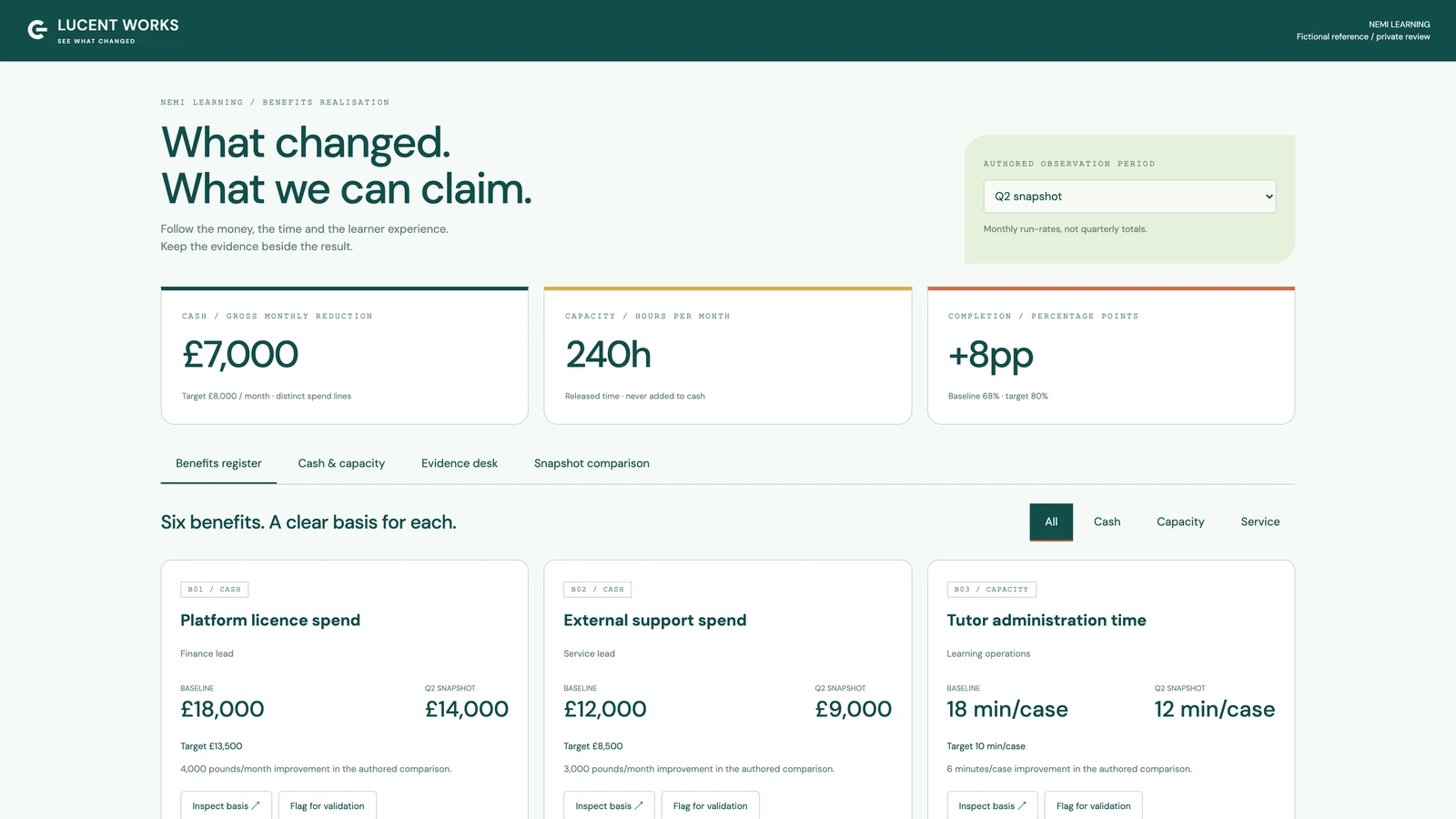
The tracker also records tutor administration falling from 18 to 12 minutes per case at a Q2 volume of 2,400 cases a month. That gives 240 hours of calculated monthly capacity. It does not show that the time was spent on learner follow-up or converted into cash savings.
The theory-of-change question is therefore practical: what evidence would connect released time to useful learner support? The tracker alone does not supply that link.
Lucent Works × Nemi Learning · example benefits tracker
Build the model with the client
Start with the change. Work back to the conditions.
Define the intended outcome, population and timeframe. Ask what would need to change immediately before it, then identify the actions and resources that might make that possible. Invite challenge from people delivering and experiencing the intervention.
Write the causal claim
For each important link, complete: “If this happens, then this change is expected, because…” Add the conditions that make the explanation plausible. Keep a source or an explicit hypothesis beside the claim.
Specify a meaningful check
Choose an evaluation question, a measure, a source and a collection point. Identify what would weaken the explanation. A convenient measure is not automatically evidence for the causal link that matters.
Review the boundaries
Record external influences, potential unintended effects and decisions outside the programme’s control. Update the model when evidence changes the explanation. A revised assumption can be useful learning rather than a failure to defend the original diagram.
A model outline, causal-link worksheet and evidence plan. Editable text template · no email required
Bring the brief and evidence into Practice, then develop the model and explanation alongside the client’s work. Explore the workspace below.
Keep the brief, evidence and client work together.Product demo
Useful answers
Before you begin.
What is the difference between a theory of change and a logic model?
A logic model usually makes the programme’s inputs, activities, outputs and outcomes visible. A theory of change develops the explanation of how and why those connections are expected to work, including assumptions and context. The terms overlap, and either format can include both.
Which should I create first?
Begin with the decision your client needs to make. A simple logic model can expose missing links quickly; developing the causal explanation may then change that model. Iteration is often more useful than insisting on a fixed order.
What is the difference between an output and an outcome?
An output is something delivered by an activity, such as a completed support conversation. An outcome is a change associated with the intervention, such as a learner receiving useful help. A delivery count alone cannot establish that change.
Does a theory of change prove impact?
No. It sets out a proposed explanation that evidence can test. Attribution requires an appropriate evaluation design and attention to alternative explanations. Use the model to decide what evidence to collect.