The client
The organisation and people you work with.
Engagement management software for consultants
The brief, the evidence and the work you owe the client. Connected to one engagement.
A client relationship can span years. Each assignment still needs its own purpose, sources and deliverables. Use Practice to keep that working context close as you prepare, review and hand over the work.
The organisation and people you work with.
A defined assignment with its own brief and boundaries.
The outputs the client needs to inspect, accept and use.
Inside the portfolio
Maren House needs a clearer route from returned furniture to a disposition decision. Caldris’s assignment covers one distribution centre, a diagnostic, a 20-case pilot and an operating handover. It does not include a warehouse-system build or ongoing operations.
 ×

Follow the assignment
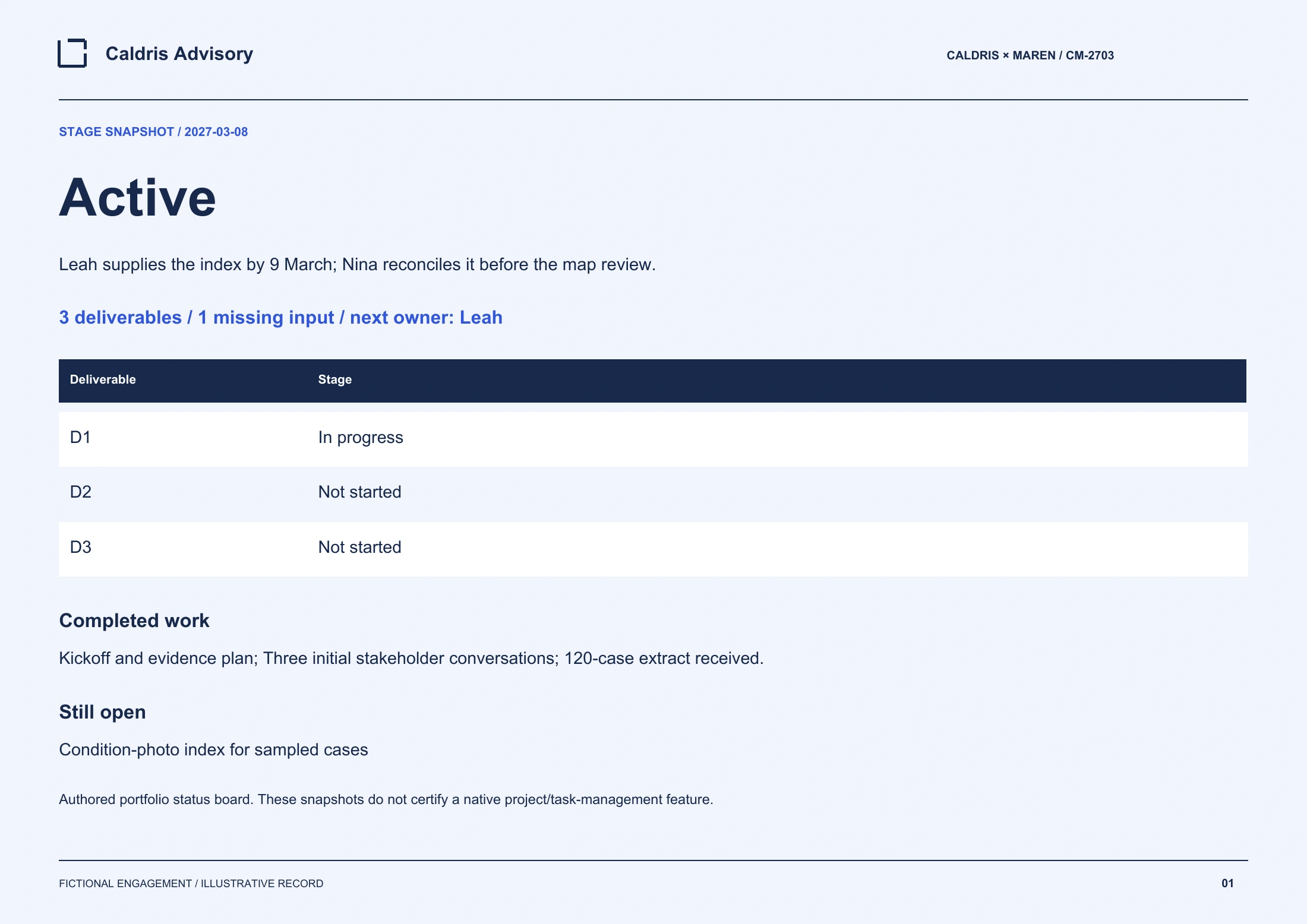
Inspect three moments in the same engagement. Notice how the remaining input, responsible person and next action change. A polished deliverable does not replace a clear decision or an agreed handover.
Caldris Advisory × Maren House
One distribution centre. Three agreed deliverables. A controlled pilot before wider change.
In progress
Not started
Not started
The remaining input
Leah supplies the index by 9 March; Nina reconciles it before the map review.
Owner: Leah GrantExample engagement review
A working routine in Practice
Start from the client and create a separate engagement for the assignment. Name it clearly, record the brief and select the right engagement when working in the workspace.
Keep source material and generated work associated with the assignment. Before closing it, check what the client has accepted and document any remaining responsibilities.
Organise active and closed engagements, with the brief, evidence and deliverables close to hand.
Record the decision the client needs, what you will deliver and what is excluded. A new assignment deserves its own brief.
Use the relevant source files and client context. Distinguish received material from an input that someone has promised to supply.
Check deliverables against the brief. Keep unanswered questions and requested decisions explicit in the working materials.
Record acceptance, explain the usable output and name the owner of residual actions. Closing the engagement does not mean every client action is finished.
Evidence before conclusions
The example uses 120 historical return records and a separate 20-case pilot. Those are different samples. The report explains the operating choices without presenting the pilot as proof of financial savings or a causal improvement.
The missing-owner and missing-photo counts overlap. Counting both without removing the overlap would exaggerate the problem.
One incomplete case is held, checked again and released. The example distinguishes a controlled hold from an unsafe release.
The client takes responsibility for exception checks and a later review. Those responsibilities survive the consultant’s handover.
Inspect the work
Read the complete report and its supporting documents. These are final reference editions, not historical snapshots of what was available at each review date.
Caldris’s example report connects the source evidence, a bounded pilot and the work Maren’s team takes forward.
Download the five-page reportOpen full-size page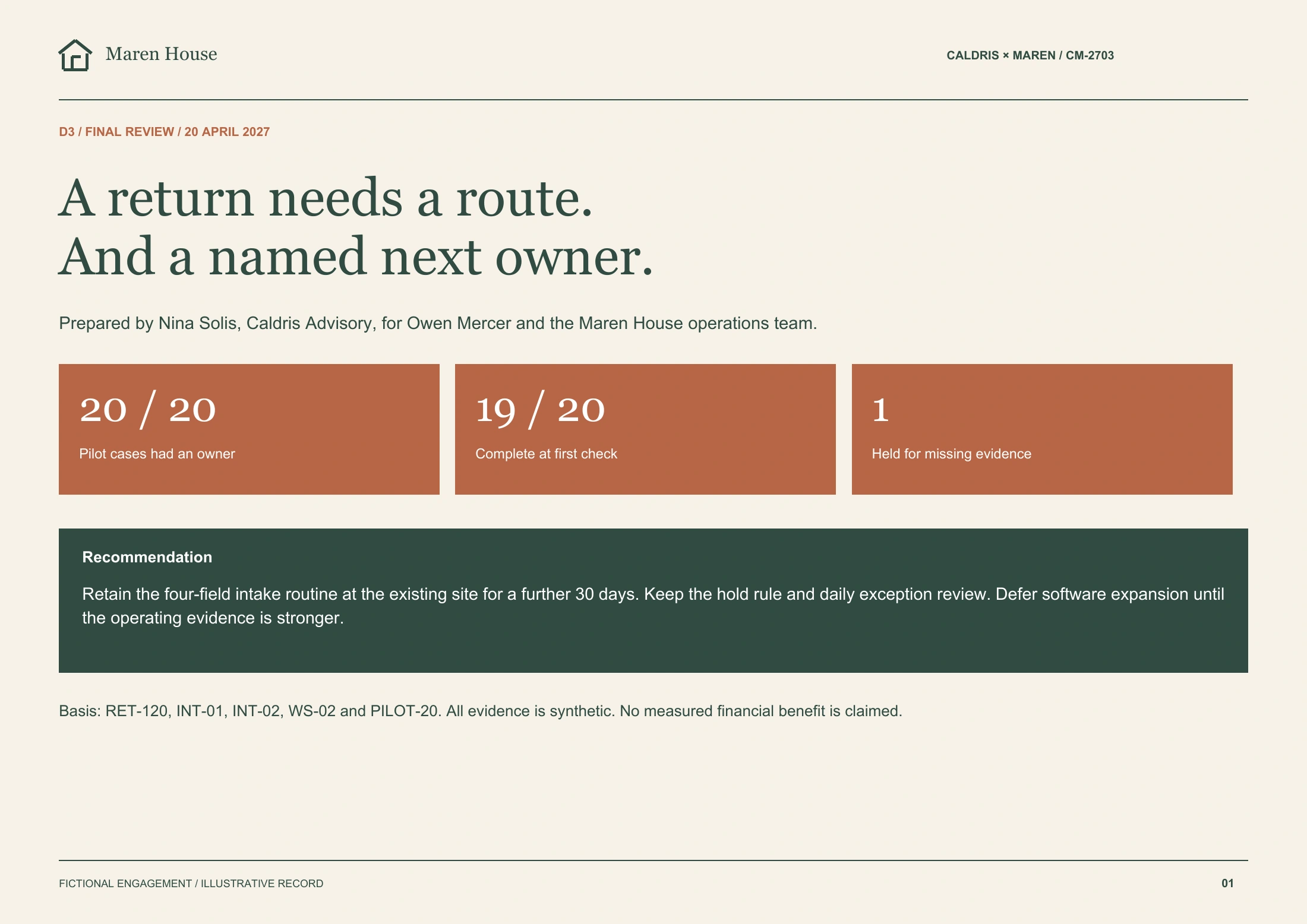
Maren House
CALDRIS × MAREN / CM-2703
D3 / FINAL REVIEW / 20 APRIL 2027
A return needs a route. And a named next owner.
Prepared by Nina Solis, Caldris Advisory, for Owen Mercer and the Maren House operations team.
01
20 / 20
Pilot cases had an owner
19 / 20
Complete at first check
1
Held for missing evidence
Recommendation
Retain the four-field intake routine at the existing site for a further 30 days. Keep the hold rule and daily exception review. Defer software expansion until the operating evidence is stronger.
Basis: RET-120, INT-01, INT-02, WS-02 and PILOT-20. All evidence is synthetic. No measured financial benefit is claimed.
Inside Practice
Explore a separate prepared client-workspace demonstration. It shows the Practice interface; the Caldris documents above demonstrate the substance of an engagement.
Useful answers
The client record represents the wider relationship. An engagement represents a particular assignment: its purpose, brief and related work. Keeping assignments distinct helps avoid mixing the evidence or deliverables from separate projects.
Review the agreed deliverables, record the client’s acceptance, provide usable handover materials and identify unresolved actions and their owners. Closure should not imply that unverified payments or client actions have been completed.
Use the project handover and acceptance checklist
Bring the work together
Keep each assignment connected to the client, its context and the deliverables you are preparing.